“I will come. I will find the way, or I will make the way.”
Note: This narrator’s face is blurred at their request for privacy.
Ariana’s life in Iran was filled with pain and violence against her, one that is difficult for her to reflect on even in the present day. She faced discrimination and violence in her life due to her religious beliefs, political opinion, and gender, which made her escape Iran. In this section, Ariana explores her reasons for fleeing Iran, as well as the process of fleeing and arriving in Japan.
Ariana’s unbreakable spirit echoes through her motto. These powerful words show how Ariana, a female refugee who has faced the fear of persecution in Iran, has always found a way to overcome the challenges she faced during her journey from Iran to Japan. Being targeted by the Iranian society, her school, and even her own family, Ariana faced violence and discrimination based on her religious beliefs, political opinions, and gender. Ariana’s motto follows her throughout her whole journey as her determination and strength have allowed her to escape Iran.
1. Emigration Around Ariana
Ariana never imagined leaving Iran to build a life somewhere else; she considered Iran her home and she wanted to grow old there. Ariana often spoke about the deep connection she felt to her homeland, the rich culture, and the sense of belonging she felt as a patriot. However, despite her love for her homeland, she faced violence and oppression in a place that was special to her. This underlines the complex concept of home, which is underlined in Gloria Andaluzia’s words: “This is my home, this thin edge of barbwire.” Andaluzia’s quote acknowledges the complexities of one’s home, marked by both the harsh realities of violence and oppression and violence and the enduring love and connection one has with their roots.
For Ariana, a home was not just a geographic location; it was a collective of memories, traditions, and a dear love she felt for Iran. Despite realizing the challenges within Iran, she held onto the belief that it was her home, a place where her identity was deeply rooted. Her dreams, however, extended beyond the borders of Iran. Ariana had a longing to explore the world, to experience different cultures, and to broaden her horizons. Canada and Sweden were among the countries she fantasized about visiting.
“I imagined visiting other countries, but not leave Iran forever. Everywhere in the world. I wanted to visit all the world. It was one of my biggest desires when I was a child.”
Yet, in her dreams of global exploration, there was a constant thread — the desire to return to the comfort of her own home. Even as she envisioned discovering new landscapes, meeting diverse people, and embracing exciting experiences, Ariana held onto the idea that her journeys would ultimately lead her back to the familiar embrace of Iran, the place she unconditionally called home.
As a young child, Ariana witnessed the courageous decisions of her close family members, including her grand cousin, a retired army colonel, and her uncle, an aspiring doctor who recognized the ominous signs of high inflation and worsening economic conditions indicated in newspapers and decided to leave in anticipation of the impending political storm of the Islamic Revolution. Fueled by education and political insight, they foresaw the impact the governance of the Islamic Republic would have on their lives, prompting a bittersweet departure from their homeland in pursuit of a more secure and hopeful future abroad.
Highly skilled and educated individuals, like Ariana’s relatives, left because of the economic recession and bad governance associated with the Islamic Republic’s leadership. Known as the “brain drain,” by 2020, about four million Iranians had gone to live in other countries. However, one million of these four million did not leave Iran as a migrant (who is able to safely return to their home countries), but rather as a refugee seeking asylum for their safety.
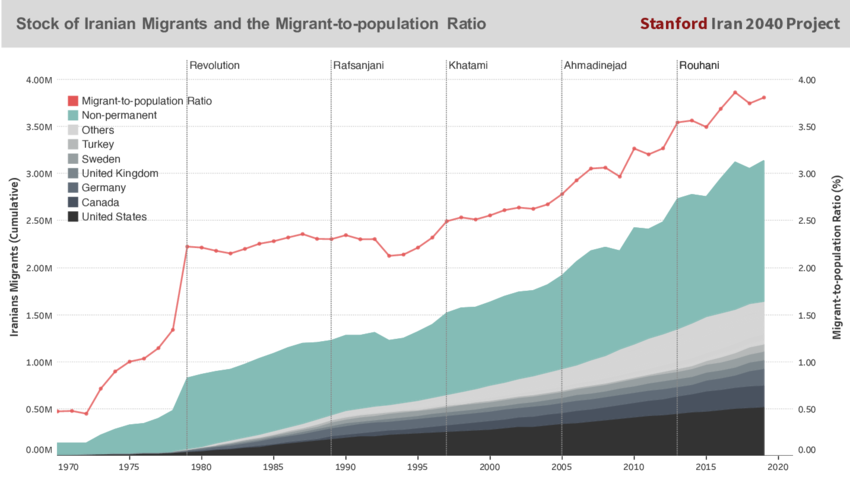
While her relatives chose to move for a better life as migrants, Ariana faced a different situation. She had to escape violence, and her only option was to seek safety as a refugee. The word “refugee” hung heavy on her dreams, as it changed her dreams of growing old in her beloved country, Iran. The tough realities of questioning her beliefs and dealing with restrictions for women in Iran made her realize staying in Iran was dangerous. Her childhood dreams faded away as she grasped the harsh truth – her life was at risk if she stayed in Iran.
2. The Unseen Battle: Persecution Across Different Spheres in Ariana’s Life
“There was a lot of violence. There was a lot of violence against my will, against my casual rights in my life.”
Ariana’s life in Iran was filled with pain and violence against her, one that is difficult for her to reflect on even in the present day and unfortunately left her with post-traumatic memory loss, making it difficult for her to remember details. She faced discrimination and violence in her life from multiple fronts, including by people whom she trusted and was closest to such as her brothers and father.
The harsh realities she faced as a “liberated” woman in Iran, exemplify the very definition of persecution: “the targeted mistreatment of individuals or groups based on various factors like political opinion, religion, and nationality.” However, in Ariana’s case, gender also plays a pivotal role in her escape from Iran.
2.1. Religious Persecution
Ariana has always had an interest in learning more about her culture and history even as a kid. Particularly, she enjoyed reading poetry, emphasizing that many Iranian poets use their poetry as a way to express their opinions and feelings towards Iran and the religious leadership. However, using poetry as a form of resistance against religion is criticized in the Quran. Consequently, the Islamic Republic also sees poetry as a “threat” to their leadership, discouraging and targeting artists and poets speaking against their regime. Yet, Ariana’s favorite poet still describes his intake on religion indirectly in Ariana’s most liked poem known as “The Footsteps of Water”:
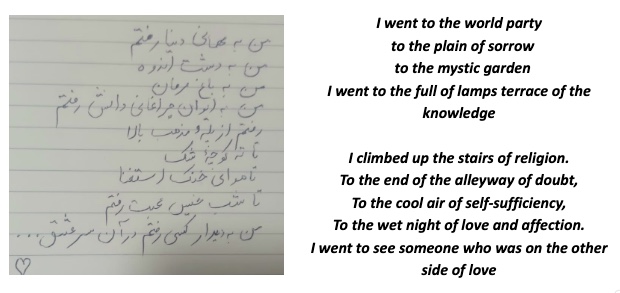
Ariana explains that this poem represents Sohrab Sepehri’s desire to receive “cool fresh air,” where he aims to discover life outside of religion. Ariana similarly received a “cool fresh air” – life outside of religious restrictions – as soon as she renounced being Muslim at the age of 40, emphasizing that she “pass[ed] from religion to humanity and love.”
Questioning Islamic Rules
Ariana’s journey through faith began in the embrace of a household where religious principles were more than doctrines; they were the very basis of her upbringing. However, with each passing day of her childhood, she found herself questioning the Islamic principles she had been raised on more.
“I asked about my rights which were opposite to Islamic rules. And also about my wishes that were opposite to the Islamic rules.”
Ariana felt puzzled by the rules that controlled her life such as her actions around men and her choices in clothing and activities. As a young woman living under the rule of the Islamic Republic, she felt like her freedom and happiness was taken away. Looking at old photos from her mother’s youth in the Pahlavi era deepened her confusion. In those pictures, her mom wore colorful and stylish clothes and played on the basketball team. However, it was not her reality: Ariana was not allowed to wear colorful and beautiful clothes and she was prohibited from engaging in activities she liked such as singing and dancing.
As Ariana compared her mother’s vibrant past to her own constrained present, she could not help but wonder how different life might have been if she had grown up in that era. The desire to dress nicely and freely join activities felt like a distant dream, taken away by the boundaries set by her Islamic upbringing. The simplicity of her wishes clashed with the complexities of her reality, creating a quiet turmoil within her. Wanting to make sense of the Islamic rules, Ariana took every opportunity to expand on her understanding and knowledge about her rights and Islamic rules. This included asking her religion teacher in school about some principles of Islam she did not understand.
Sadly, the teacher’s response fell short. Instead of answers, she just told her to stop questioning and accept the rules. This did not sit well with Ariana. It did not silence her curiosity; it fanned the flames. She wanted to know why religion put a limit on her freedom and rights, especially as a woman. As Ariana continued reading books about Islam and searching for answers, she understood that there was a clash between what she believed and what she was told. This became a turning point in her story.
Rejection of Islam
“I saw a lot of paradoxes. Between being a good and happy human or woman. There is no difference between men and women as a human. But, there was a paradox in the book, the Quran.”
After searching for answers by reading more books about the Quran and Islam, Ariana found some specific aspects of Islam that are reinforced by the Islamic Republic that she finds unacceptable, explaining them as some of the paradoxes represented in the Quran.
Ariana identifies paradoxes in the Quran regarding the treatment of men and women. The Quran 4:34’s verse is often translated in Iran as: “Men are the maintainers of women because Allah has made some of them excel others and because they spend out of their property; the good women are therefore obedient, guarding the unseen as Allah has guarded; and (as to) those on whose part you fear desertion, admonish them, and leave them alone in the sleeping-places and beat them; then if they obey you, do not seek a way against them; surely Allah is High, Great.”
“In the Quran, you can read that God asks men if their wife does not obey you, you can beat her, but try to beat her not very hard.”
In Iran, the Islamic Republic interprets the different verses of the Quran to support its political ideology and rhetoric. In this case, this verse can be understood differently based on the different translations, yet the Islamic Republic of Iran utilizes this particular translation to justify the gender inequality created by their regime. This artificial gender inequality created by the Islamic Republic aims to contribute to a divide between men and women, leading to differing and hostile opinions between the genders. The strategy of creating gender-based divisions serves to distract from other socio-political issues, deflecting attention away from concerns such as economic hardships, political dissent, and human rights abuses. By manipulating gender dynamics, the regime attempts to shift public focus, creating a divisive narrative that redirects attention from broader societal challenges.
However, this gender inequality not only distracts society from the actual problems affecting Iran but also creates a gap in policies regarding men and women, as they face different legislation. Legislation regarding men is less strict creating a higher level of support towards the Islamic Republic, while women face strict legislation in every area of their lives such as the mandatory hijab policy.
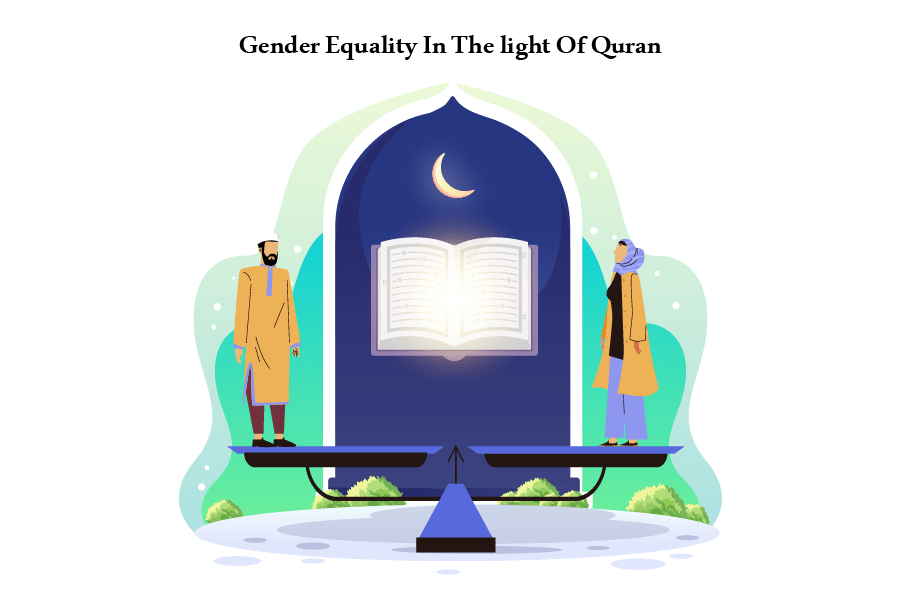
The strict policies on women have had a direct impact on Ariana’s life as well. Ariana has always been a person who liked beauty and colors. Yet, as a child, she was forced to dress up according to the rules of the Islamic Republic. Even though Ariana did not agree with having to wear a hijab, she did not have any other choice but to hide her true opinion and pretend that she was okay with wearing the hijab.
The Islamic rules imposed on her stifled her ability to express her genuine opinions and beliefs. Yet, despite the constant need to lie and pretend, honesty remained a fundamental aspect of Ariana’s character, and she grappled with the internal conflict caused by the need to suppress her true self. For Ariana, honesty served as a guiding principle because she believed that genuine self-expression was essential for personal integrity and a sincere connection with others. Further, she couldn’t pretend to like a system that abused her rights. As Ariana matured, her commitment to honesty shone through, and she took a stance against the restrictive norms by not wearing the hijab, which made her a “rebel.” This resulted in violence against her by the morality police.
The expectation of blind faith and the narratives of the government are deeply rooted in the political ideology of the Islamic Republic, creating a climate where questioning or dissenting voices are perceived as threats to both political and religious stability. In this environment, individuals who challenge the prescribed narrative risk facing severe consequences, reinforcing a culture of conformity and limiting the freedom of expression within Iranian society. Ariana’s parents believed blindly in the narratives of the Islamic Republic which included the notion that one could only be happy if believing in Islam. In her upbringing, Ariana was also taught that she could only be happy if she complied with the religious rules. Yet, Ariana was not happy with the limiting aspects of the Islamic rules and she could not believe that she would be able to be happy living under Islamic rules.
“My parents and the school and society told me that if you want to be a happy and good person, you need to be a religious person in Islam. I tried to be. I believed them first.”
40th Birthday Party and Reaction to the Reveal of the Rejection of Islam
Ariana could not fake believing in Islam anymore. Tired of pretending to be a devoted Muslim, at the age of 40, she decided to organize a birthday party for herself, where she would reveal her decision to renounce being a Muslim. She invited her close friends and family, both male and female, wanting to break the gender barrier. Yet, this was against the rules of the Islamic Republic.
She made it clear to everyone: no dress code, no mandatory hijab restrictions. Freedom was the theme of her party, a rebellion against the suffocating rules of the Islamic Republic. For Ariana, freedom meant being able to be yourself and enjoy your human rights in complete safety without being exposed to danger or violence.
As a show of her rejection of Islam, she went up the stage without a hijab and spoke about freedom and how rejecting Islam helped her find her happiness. Later, she sang her favorite songs on the stage, using them as a way to show that without religion she is able to do the activities she likes more freely. Her aim was to emphasize that happiness is not tied to religion, rather it is a feature of freedom.
As Ariana was singing on the stage, she realized that her open rejection of Islam would have consequences on her relationship with her family and loved ones. She wanted to cry and had to hide her tears whilst singing, as she was slowly understanding that this action would isolate her from her loved ones, who did not agree with her decision. Ariana’s plan to show that there is happiness without religion backfired. Her father was a no-show, her mother’s disappointment was written all over her face and her brother became violent towards her at the birthday party. Her mum even said, “I ask God to help you to return your brain back.”
It hurt Ariana, but she was not ready to give up: “It was really painful for me, but I didn’t want to stop. I continued. I tried to let them know there is a lot of nice and safe happiness (without restrictions and being targeted for choosing) here between us,” she describes.
Ariana knew that with her open statement, her new life would start, a life isolated from her loved ones but freed from the limiting principles of Islam. She consciously chose to be open about her opinions instead of suppressing her true self and obliging by the rules of Islam. She explains, “I always try to remember that when you have two choices in front of you, the difficult way is always the correct way, not the easy way. So, when you are doing the correct activity, it will probably be hard.”
By organizing her birthday party on the theme of freedom and publicly declaring her rejection of Islam, she chose the more difficult option. But this event has also become one of the most defining milestones in her life. After the party, she felt like “the party was very valuable for me. Maybe more than my car and more than my home.”
The rejection of Islam was one of the factors contributing to Ariana’s decision to flee, as she could not live in a strict Muslim country where the religion intersects with all areas of life. Based on the rejection, she directly experienced religious persecution described as “the systematic hostility or ill-treatment encountered by an individual or group because of their religious beliefs.” Ariana’s rejection of Islam and escaping the Islamic rules of Iran fits into the bigger picture, as since the Islamic Revolution many Iranians renounced the religion. Despite the claim of the Islamic Republic that 99.5% is Muslim, new studies reveal that this ratio has changed since 1979 with only 40% identifying as being Muslim. As conversion from Muslim to non-Muslim is punishable by death according to the 2022 Penal Code, many of those who rejected the religion face the fear of being executed leading to religious persecution. In fact, religious persecution is among the top reasons for Iranian refugees to seek asylum elsewhere. However, Ariana’s persecution was only based on religious accusations by her own loved ones, but gender-based violence and persecution also played an important role in her decision to flee.
2.2. Gender-Based Violence and Persecution
Systematic Abuse
In a system that encourages men to oppress women and undermine their safety, the absence of hijab becomes the pretext for persecution, revealing a government’s disturbing agenda. Ariana personally experienced how refusing to wear the hijab can result in violence against her.
However, this was not the only interaction Ariana experienced with the morality police. She emphasizes how almost every time she left her house she had some trouble with the morality police. The morality police’s consistent interference in Ariana’s life exemplifies their role as enforcers of a discriminatory and repressive system, perpetuating gender-based oppression. In particular, the morality police, officially known as the “Guidance Patrol,” is a law enforcement unit tasked with enforcing Islamic dress codes and moral behavior for men and women, particularly in public spaces within the legal framework of the Islamic Republic.

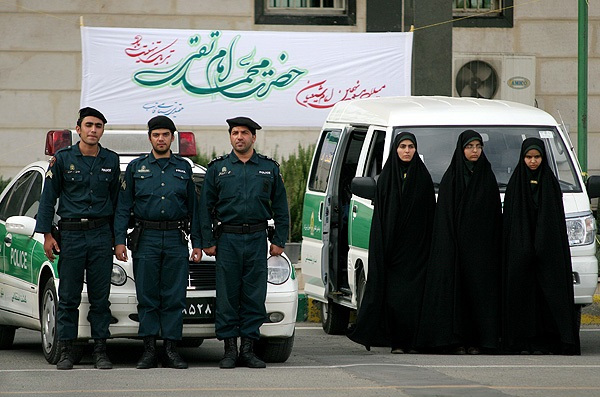
Right: Morality police in action (Reuters)
“The system asks men in an indirect way to not let women be safe.”
Yet, Ariana was not afraid of the morality police, or other units of the Islamic Republic that oppress women. Rather, it was mostly the Iranian men who were not letting women be safe and “brainwashed” into believing that they had to “enslave women.” Her shyness towards men developed in her childhood when they wanted to teach her that girls are supposed to obey men.
Beauty, Men, and Sexual Harassment
“They [men in the Islamic Republic] thought having beauty for a girl means not having safety.”
Ariana, a woman of captivating beauty, found herself entangled in the harsh realities of Iranian society, where concerns about one’s appearance were met with taboo and peril. As she navigated the intricacies of femininity, Ariana was a target for gender-based and sexual violence, a consequence of the societal norms that deemed expressions of beauty as forbidden. In a society where “if you let others notice you, you are not safe,” Ariana’s journey was marked by the constant struggle to balance her desire for self-expression with the risks that accompanied it. Ariana has been targeted sexually multiple times by her school, workplaces, and even strangers who she has never met before. From her childhood, it was an issue she constantly had to face.
As a young girl, Ariana did not know that she was sexually harassed at her workplace. However, looking back, she realizes that she was the target of verbal sexual abuse due to her beauty and gender. However, as she evolved into a prettier and more mature woman, her beauty was recognized more and more, sometimes putting her physical safety and life in danger. Ariana remembers how one time she was almost kidnapped because she was recognized by a stranger who wanted to take advantage of her.
Ariana remembers that it was getting dark, and she was following the driver to his car. Initially, she felt safe. However, as she realized that the driver was not following the given route, she felt fearful for a second. Yet, her honesty and strength turned this abduction incident into an escape for her. When she realized that the men in the pick-up truck were intending to take advantage of her beauty, she gathered all her strength and got ready to beat her fear of men. She said to the man who initially wanted to hurt her: “I’m married and my husband and my brothers live in this area. You are also living in this area. I can understand that you as a man in this country have a kind of gender hunger for your opposite gender. I understand you. But if you do this with me, you cannot continue your life.”
Her statement hung in the air, as it made the driver of the pickup truck think. She showed her strength and refused to be a victim of his “gender hunger.” After a while, the man realized that Ariana would give up fighting and trying to escape, as she took charge of her safety. This made the man let her go without hesitating. Ariana’s journey through the harsh societal norms of Iranian culture paints a vivid picture of the challenges faced by women who dare to express their beauty in a society where such expressions are deemed forbidden. Her experiences, ranging from sexual harassment in the workplace to the terrifying incident of almost being abducted, underscore the pervasive nature of gender-based violence that she, like many other Iranian women, had and continues to confront.

Domestic Violence
Safety completely slipped away from Ariana’s grasp as her own family, meant to protect and accept her, turned against her upon her renouncing her faith. Growing up in a strict religious family and then marrying a man with traditional views and family resulted in Ariana facing violence not only from society but even in her own home.
“They tried to catch my freedom, didn’t let me sing physically, and tried to hit me, beat me.”
Ariana was always vocal about her opinions regarding the rules of the Islamic Republic and the religion. As she openly expressed her opinion, she received violence as a response from her brothers. Ariana explains how she was abused several times physically by her own siblings who were meant to protect her. Therefore, she never felt safe even surrounding her own immediate family.
When Ariana fell in love for the first time in her teenage years, she expected to be cared for by her first boyfriend. However, this relationship was one-sided and the boyfriend did not provide her with the love she needed. This first teenage love did not initially lead to marriage as they parted ways due to the boyfriend’s family’s disapproval. However, later in Ariana’s life, she got in touch with her first boyfriend again, this time leading to marriage.
Ariana experienced similar treatment from her husband, as in their teenage relationship, as he did not give her the love she was willing to share with him. But this time, she was not only not cared for, but threatened and abused. Due to her husband’s drug problem and his family’s negative view of women, her husband’s behavior was physically and verbally violent toward her.
“He always wanted to kill me and he told me that ‘I want, I will kill you if you don’t obey me.’”
The turmoil Ariana faced within her own home was a haunting reality that overshadowed her every moment. Her husband’s descent into addiction mirrored a disturbing trend sweeping through Iran, where a staggering 20% of the male population grappled with substance abuse. The usage of drugs is associated with a higher likelihood of domestic violence and abuse in Iran.
As her husband fell deeper into addiction, Ariana watched helplessly as he transformed into a stranger consumed by drugs. Behind closed doors, their home became a battleground tainted by domestic violence. Ariana felt trapped in a cycle of fear and despair, yearning for escape.
With the trauma unfolding, Ariana’s memories started to blur and fade, leaving her feeling lost and confused. The pain she endured left scars that ran deep, haunting her even after the storm had passed. Post-traumatic memory loss became her way of coping, shielding her from the horrors she couldn’t bear to remember. Ariana not only experienced threats for herself but her children were also abused by her husband. She wanted to create a safer space for her children, breaking free from the cycle of danger for a future filled with safety and well-being.
Ariana bravely decided to end the marriage after 12 abusive years. However, as divorce initiated by the wife is rather uncommon in Iran with the divorce right being granted to the husband, Ariana decided to learn about the legal process of divorce secretly from her husband and family. She spent countless hours pouring over books, researching online resources, and seeking advice from individuals who had experience with the court system regarding divorce. Despite the long wait, Ariana stayed determined to break free from her abusive marriage. She kept pushing forward, knowing her bravery would pay off. Finally, after two years of hard work and perseverance, the judge granted her divorce.
Ariana’s divorce was rare and unique as granting a divorce right to the wife is unusual in Iran. In the court, she had to “prove that remaining in the marriage is causing adversity and inadequacy in her life.” For Ariana, it was an especially hard legal journey as it was hard for her to remember the details of her abuse due to her post-traumatic memory loss. Similar to many Iranian women, Ariana had experienced disagreement from her family when she divorced, leading to more isolation and more difficulties taking care of her children. Yet, her family’s reaction was not surprising, as divorce initiated by the wife is seen as unacceptable in Iran.
Ariana’s experience with violence, abuse, and mistreatment based on her gender constitutes her gender-based persecution referred to as “violence against persons because of sex characteristics and/or because of the social constructs and criteria used to define gender.”
2.3. Motherhood and Creating a Better Future for Her Children
“I can remember myself before I was a mother. My life has not enough meaning, especially in Iran.”
Despite all the violence and mistreatment that Ariana experienced, Iran remained close to her heart as she considers herself a patriot. If it were not for the widespread systematic corruption and unimaginable insecurity for her, she would have preferred to stay in her country. Becoming a mother has given Ariana’s life meaning; it gave her a sense of responsibility and bravery to take her life into her own hands. Her love for the next generation became a driving force that empowered Ariana to leave her homeland, seeking a safer and brighter future. Ariana’s story on how motherhood encouraged her decision to flee can be an example of a bigger trend of Iranian mothers seeking a better life for the next generation amidst challenging circumstances.
3. Fleeing
Deep down Ariana knew that her future was safer outside of Iran. However, it was the year 2016 that marked the beginning of her quest for freedom, as she publicly declared her rejection of Islam to her loved ones. With a sense of urgency, Ariana embarked on her first attempt to flee seeking refuge. In 2016, she applied for a Japanese visa eager to escape the oppressive environment of Iran. However, her hopes were crushed when the visa application was rejected.
Undeterred, Ariana’s determination led her to a new avenue for escape. In the spring of 2017, she successfully secured Russian visas, and she fled to Russia with the hope of crossing the border to Norway and starting a new life there. In the summer of 2017, she made it to the Murmansk (Russia-Norway border), where she desired to cross with a bicycle.
Yet, she was stopped by border control and she had to explain the reasons why she was trying to cross the border. Ariana was brave and tried to tell her story honestly to the police guards: she did not come up with excuses, she explained the harsh reality she was facing back in Iran. The border control could not comprehend the dangers she was facing back in Iran, and unfortunately denied her entry into Norway.
After being denied entry, she decided to go back to Iran and find another way to escape. This time she took help from an Iranian man whom she was dating at the time, who advised her that the Japanese visa would be the most feasible to acquire for her situation. She applied for a visa to Japan for the second time in 2018, and this time, it was accepted. She made her way to Japan, arriving on the 6th of September, 2018.
“You are not suitable for living in Iran, in this religion, in this tough regime. You need to live in a country, in a free country.”
Ariana’s parents initially showed their discontent with her decision to flee Iran, but later on, after Ariana left Iran, they realized that it was for her own good. Whilst being silent for years and seeing Ariana suffer, her mother eventually broke the silence, admitting that Iran was not a suitable place for her daughter. Now, Ariana’s parents even regret their approach to the upbringing of their daughter, and they wish they had not lost Ariana forever, saying “You cannot stop your family. You cannot stop your daughters. We tried to stop Ariana, but Ariana left us and went for her freedom. So, if you don’t want to lose your daughters, I offer you that, do not try to catch their freedom.”
4. Arrival in Japan
4.1. Freedom in Japan
“For the first time I could enjoy my freedom and safety together.”
Despite facing numerous challenges upon arriving in Japan including navigating through the legal process of receiving refugee status, finding safe spaces and belonging amongst diverse communities, and obtaining a stable occupation to sustain herself. Ariana felt that her earlier experiences in Japan were her first time having safety and freedom together. One memory is embedded in her mind, when she went to the beach in the outskirts of Chiba prefecture for the first time without hijab, with her sharehouse roommates from Chiba House in 2019.
Even going to the beach, Ariana had experienced limitations to her freedom and safety in Iran, but when she came to Japan and stayed at Chiba House, she suddenly could experience both. She bravely encountered many first-time experiences, including going to the beach without dress restrictions, breaking free from Iran’s clothing rules, and boldly opting to wear a swimming suit. Chiba House became a special place where Ariana could be herself and enjoy life without the restrictions she faced before.
4.2. Persecution in Japan
Whilst Ariana hoped that her harassment and persecution were over, it was not the case for her; violence against her by Iranians continued in Japan. Particularly, the Iranian man whom she dated at the time of coming to Japan continued to target her even when Ariana ended their relationship. He stalked Ariana, followed her to places, and begged her to continue their relationship. Initially, this ended with Ariana getting a lawyer to protect herself and was ultimately able to get a restraining order against him.
After a while, he went back to Iran but the targeting continued online. He left comments on Ariana’s and her friend’s social media accounts trying to spread false information about her, always telling them that “She’s a bad woman and she’s a liar, or she’s an agent of Islamic Republic.” This online targeting escalated to an extent where she received anonymous messages threatening her life from accounts that were connected to this man. This trend continued for a while causing Ariana significant distress, yet with time it eventually stopped by limiting her comments for a long time.
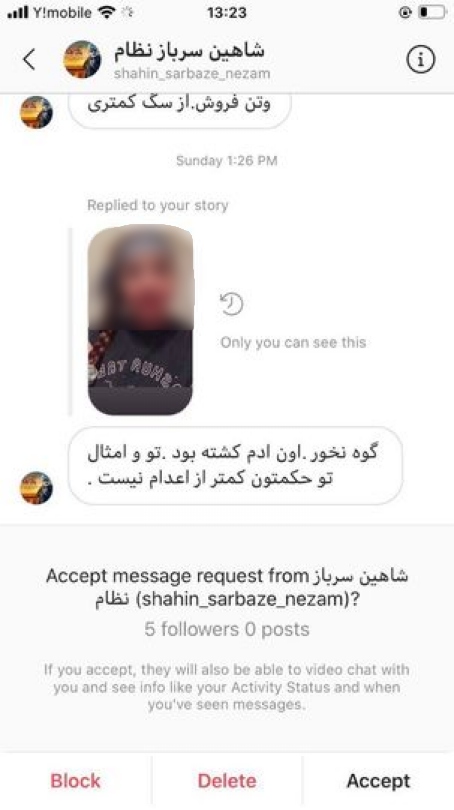
Context: This is a death threat to Ariana by an Islamic Regime cyber agent that was a response to Ariana’s post supporting one of the young political activists who got executed by the Islamic Republic.
Translation: You and people like you will not have any less than an Execution Order.
Interpretation: Ariana openly expressed her support for an activist opposing the Islamic Republic. She received a death threat for raising awareness against the Islamic Republic.
Context: This was a private message on Ariana’s Instagram threatening her and her family based on her open rejection of Islam and refusing to wear the hijab. It was a message on Ariana’s personal Instagram by an agent of the Islamic Republic.
Translation: You are babbling about Iran but what positive contribution have you and your family made to Iran? So why are you babbling about your homeland again? What Iranian woman shows her body with no hijab in public eyes? Your words and acts are opposite to each other, and we can see that clearly. Do not try to encourage others. I already gave you notices and warnings. Do not pass our red lines…
Interpretation: Ariana openly removed her hijab and expressed her opinion against the Islamic Republic. She received threats if she continued for herself and her family.

The threat Ariana received on social media
With being targeted online in a so-called “safe country,” Ariana experienced transnational repression which is defined as a form of political repression practiced by an authoritarian regime beyond its own borders, typically aimed at individuals conducting activism against the regime beyond its borders. Ariana’s experience with the threats from different agents of the Islamic highlights how even after escaping direct persecution, one can be in danger and targeted online.
“They couldn’t see me as a human. They just wanted to see me as a woman.”
