1. Beginning of Life in Japan
“Japan to me has always been a dream…immediately when I came to Japan, the image was destroyed.”
Christopher arrived in Japan on October 9th, 2012 looking forward to starting his new life. He had a positive image of Japan before his arrival and was hopeful to live in the advanced country. However, his image was immediately destroyed after being told by a few of his Cameroonian friends, who he met in Japan, that Japanese people are not foreigner-friendly and they can intentionally fall down in the street and put the blame on foreigners. Due to inadequate access to reliable information and the telling of these negative stories by foreigners who have lived longer in Japan, he believed the stories and started to live through fear. Despite leaving his country to avoid persecution, it led him to live with fear again in a different circumstance. Many asylum seekers in Japan face similar difficulties in accessing resources and finding people they can rely on due to minimal support systems and language barriers. They are isolated from the Japanese community, leading them to face various difficulties.
No matter how challenging the situation for asylum seekers in Japan is, going back to their country is not an option due to the threat that not only affects them but also their families. Christopher has a family in Cameroon and his decision to flee was not an easy choice. However, he had to flee in order to avoid the risk of his family being targeted. Similarly, many asylum seekers have no choice but to stay in Japan for the sake of their lives and the protection of their families. Thus, countries of resettlement should be responsible for protecting refugees and providing equal rights and opportunities.
2. Problems with Refugee Applications
2.1. Refugee Recognition Rate in Japan
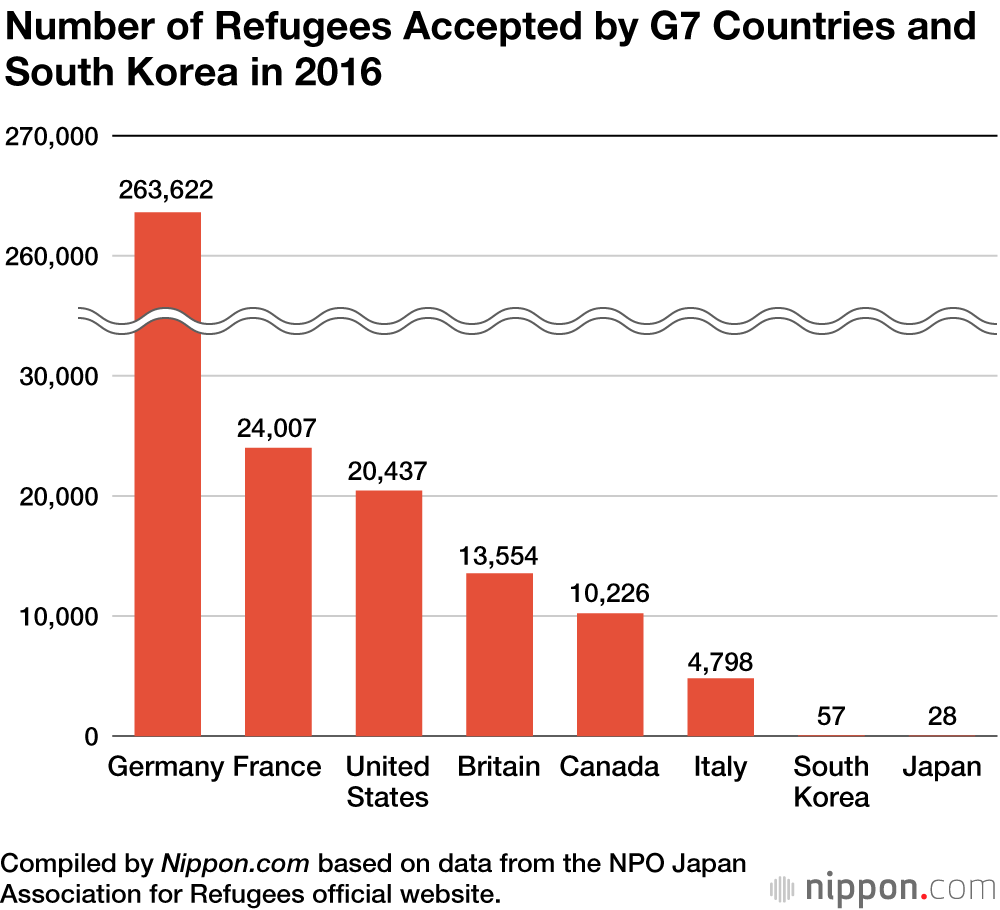
In 2019, 10,375 people applied for Refugee Status in Japan and only 44 people were accepted. This translated to an annual recognition rate of 0.42%. In fact, every year, the recognition rate in Japan is less than 1 %. The number is more evident by comparing it with the number of refugees accepted by other G7 countries and South Korea. The situation varies from country to country and it is not possible to make an easy comparison; however, it is evident that Japan takes a very small number of refugees compared to other developed countries. The 1951 United Nations Refugee Convention defines the term ‘refugee’ and outlines the rights of refugees, as well as the legal obligations of States to protect them. It asserts that refugees should not be returned to a country where they face serious threats to their life or freedom. However, it does not state a specific number of refugees that each country should recognize. Thus, Japan accepting only 1% of the applicants is not a violation of the UN Convention. However, many asylum seekers, including Christopher, believe that Japan is not fulfilling its obligations since many non-recognized applicants are under well-founded fear of persecution in their home country.

The Ministry of Justice explains one of the reasons behind the low recognition rate as non-recognized applicants being unable to sufficiently provide proof of their persecution. They argue that claims given by the applicants who are rejected do not fall under the category of persecution. Persecution refers to the act of harassing or oppressing a person which can lead to a threat to one’s life or physical freedom. According to the 1951 Refugee Convention, refugees are defined as “someone who is unable or unwilling to return to their country of origin owing to a well-founded fear of being persecuted for reasons of race, religion, nationality, membership of a particular social group or political opinion”. Thus, the Ministry of Justice claims that problems with acquaintances, neighboring residents, or the mafia are not considered applicable reasons, and applicants with such reasons are not eligible for acquiring refugee status. However, the reality is that many non-recognized applicants clearly have their reasons under one of the five protected grounds (race, religion, nationality, membership in a particular social group, or political opinion). Saburo Takizawa, an expert on immigration and refugee policy, explains that Japan has an excessively strict interpretation of the meaning of “persecution”. Under Japanese interpretation, people who escaped from the disputes in their home country (Funso Nanmin 紛争難民) are not considered refugees. Although the 1951 Refugee Convention defines the term ‘refugee’, there are inconsistencies of interpretation among countries and Japan has a strict interpretation, which is blocking many asylum seekers to acquire refugee status.
Many asylum seekers in Japan believe that their voices are not being heard and Japan does not examine each application critically. 8 years have passed since Christopher arrived in Japan and he has not yet been accepted as a refugee (as of February 2021). Within 8 years, he went through the refugee application procedure twice. Submitting the application and necessary documents is not easy for asylum seekers due to language barriers. According to the Immigration Services Agency of Japan, the average procedure duration is 6 months. Although this may vary depending on nationality and resubmission of their documents, in Christopher’s case, it took him 5 years for his first application to go through the whole procedure. This is not peculiar to his situation. In fact, most applicants in Japan wait longer than 6 months to receive the result, only to find out that their applications are disapproved. [More Information on Immigration Procedure]
While they wait for the results, their deportation order, a notification that a foreign national is legally required to leave the country, is suspended. However, they do not have a work permit or national health insurance, which makes them extremely difficult to survive. Especially during the COVID-19 pandemic, many applicants express fear of infection due to the inability to access reliable information and medical treatment with little income. Once an applicant’s refugee status is recognized, he or she is allowed to stay in Japan with an appropriate residence permit and given rights similar to those of foreigners lawfully staying in Japan. When their application is disapproved, they must make an appeal within 7 days or reapply since their deportation order will be enforced otherwise. Christopher explains that applicants are constantly reminded of their deportation orders. Those who do not have refugee status may be seen as illegal immigrants and they may be detained.
Click here to find out more information on the Detention Center.
Christopher has a concrete story of being persecuted by the Cameroonian government and he was able to collect documented proof. Despite being able to collect documents, his application was disapproved, which illustrates the difficulty and strictness of the Japanese immigration system. It is questionable whether Japanese Immigration is actually making an effort to determine who are the real refugees and who are not. By looking at Japan’s refugee recognition rate, it is evident that many asylum seekers would have had a better chance to be recognized as refugees in a different country since Japan accepts far fewer refugees.
2.2. Proving Persecution
Many asylum seekers face difficulty proving persecution since collecting documents could expose them to more danger if they were discovered before they leave. Many of them flee as soon as possible and sometimes there is simply no evidence to prove. Christopher had to submit the death certificate of his colleague in order to prove his risk of persecution. However, since he left the country within a week after deciding to flee, he explains the difficulty of preparing these documents and receiving the death certificate of a non-family member. He had to have a lawyer in Cameroon who could send his documents to Japan and it took him a great amount of time to collect them. This shows his willingness and desperation to do whatever he can to prove his persecution.
The death certificate which Christopher submitted does not identify who murdered his colleague. However, he claims that, from the torture and oppression that he experienced in Cameroon under the control of the government, it is evident that his colleague was murdered by the government. Because many asylum seekers are targeted by the authorities who have power, it is a challenge for them to collect documents, especially when they have a limited period of time to prepare.
Christopher explains that there were so many documents to submit in order to prove persecution. He even had to submit proof of his trade union activities and social media activities to prove himself that he is telling the truth.
Fortunately, Christopher was able to receive documented proof from his lawyer in Cameroon. This is an unusual but fortunate case because many asylum seekers struggle for years to find a way to collect documents from their home countries.
Despite being able to collect proof, Christopher faced another difficulty which was translating these documents into Japanese for submission. Although the application form can be found in different languages, applicants must find a way to translate their other documents into Japanese. Christopher clearly states the biggest difficulty was the language. Although he was able to receive help from his lawyer as well as from the Sophia Refugee Support Group, a student-led organization that aims to provide support to refugees in Japan, applicants generally do not have the network to find Japanese speakers who are capable of the official translation.
2.3. Rejection
Christopher’s first refugee application was disapproved in 2016. He was not surprised to find this out since he knew that it is a common flow. After spending some time in Japan, he knew the difficulty of receiving refugee status in Japan. He shows an understanding of the issue of fake refugees who come to Japan solely to work and does not blame the Japanese government for making the immigration procedure strict. He explains that Immigration has to determine who is a real refugee and who is not. And he clearly distinguishes himself from fake refugees, stating that he is in real danger if he is deported to Cameroon.
After his first rejection, he reapplied with additional documents. Since it was his second time applying and was supported by his lawyers in Japan and Cameroon, he expected to receive refugee status.
“In May 2018, when they told me, I was really disturbed…I’m not like a child running for an adventure. I’m a settled man.”
In 2018, when he received a second disapproval of his application, he was disturbed and disappointed. Without refugee status, refugees have to depend on others. Christopher describes this situation as becoming like a child. For a person, who organized the trade union and fought for workers’ rights, to be treated like a child in a foreign country is a disgrace and this is not what he wished to become. However, since Immigration does not specify reasons for rejection, it is difficult for him and his lawyer to produce counter-evidence. If a clear explanation were given as to what evidence is lacking, it would be possible to collect more documents and make an objection. He desperately claims that his situation is serious and that not accepting real refugees is a violation of human rights.
“If you go to the Immigration, don’t expect them to give you a positive answer.”
Since he came to Japan in 2012, he always expected to receive refugee status. However, his hope was destroyed every time. Comparing his attitude towards Japanese Immigration before and after the refusal of his second application, he has become hopeless and no longer expects to receive a positive answer from Immigration. From his view, Japan has specific countries that they accept as refugees. Thus, they do not study the situation in Cameroon in detail which is why his application is being disapproved.
3. Claiming Human Rights
“They [Immigration] let them [asylum seekers] work. Give them 6 months visa…but most of them are never recognized as refugees.”
Christopher says the Japanese government is exploiting asylum seekers by not recognizing them as refugees. He applied for the designated activities, a specified visa that enables him to stay in Japan for 6 months. The Designated Activities visa is different from the permanent resident, which is a type of visa that those who are granted as refugees by the government can receive. For designated activities, applicants must apply for an extension every 6 months and they must have this visa to obtain a work permit. With this visa, Christopher has worked at several companies in Japan.
Click here to read more about Christopher’s work in Japan.
Christopher claims that slow responses from Immigration and only allowing asylum seekers to work with a work permit is a violation of human rights. He is aware of the labor shortage in Japan and claims that providing a work permit but not recognizing them as refugees is a form of slavery because they are just being exploited to fill the labor shortage. Although designated activities allow asylum seekers to work, there are restrictions on work activities, and it is a burden on them since they have to renew it every 6 months and are not guaranteed that they can always renew their visa. In fact, when the applicants’ result of the refugee application is decided, they can no longer apply for designated activities. If their application is accepted, they have refugee status and are granted a permanent resident visa. However, when disapproved, they must make an appeal or reapply in order to apply for the designated activities again. Thus, it is a double burden.
The Ministry of Justice emphasizes the importance of careful investigation of applications to reduce the number of fake refugees. However, the fact that many asylum seekers including Christopher who is in real danger, are being regarded as fake refugees is unjustifiable. Distinguishing real and fake refugees is important and it is understandable that the process takes time. However, disapproving applicants who have proof of persecution is going against their human rights. There are also misconceptions about refugees that connect them to fear around public safety and risks to society, hence making it challenging for them to be accepted.
4. Support System in Japan
4.1. Lawyer
Finding a lawyer in Japan is a challenge for many asylum seekers due to financial difficulty and lack of network; however, it is an extremely important step to proceed with the refugee application smoothly. When their applications are denied, they must make an appeal and present their case to the court, and this is especially difficult when they do not have lawyers.
Fortunately, Christopher was introduced to his lawyer through a friend and he refers to his lawyer as a father in Japan.
He explains that his lawyer has helped him in various ways and they have built trust with each other. His lawyer helped him with going through the application procedure by organizing documents and explaining what he needs to prove persecution. He also got language support to translate his documents into Japanese for submission. Christopher also has a lawyer in Cameroon who has been sending necessary documents to Japan. The various ways of support that lawyers can provide to applicants show the importance of having a lawyer. However, the reality is that not everyone has access to receive legal support.
4.2. JAR/RHQ
“I went to JAR to complain that I could not, I did not like to live under somebody.”
During the immigration procedure, applicants also need financial support since they have little or no income. Christopher talked with the Japan Association for Refugees (JAR), an organization that provides aid and support for refugees because he did not want to live under somebody. He was an independent man in Cameroon, and he did not want that to change in Japan. When he visited JAR, he received support to write his personal statement of his asylum application and was provided with a temporary house. He was then connected to Refugee Assistance Headquarters (RHQ) for financial assistance. RHQ provides refugee applicants with financial support for living expenses, rent of accommodation, and medical expenses. These supports are provided for those who are recognized as facing financial difficulties based on an investigation by RHQ. Christopher states that he was well-supported by these two organizations.
4.3. Further Support and Change Needed
“Japan is a closed environment. And being in a closed environment, I think any foreign person inside is an alien from the start.”
Although Christopher was fortunate enough to be able to receive help from organizations and lawyers, he has not yet received refugee status. Considering his situation, further changes are needed in society and the government. Christopher states that Japan is a closed environment where people do not try to see the outside world. There are various difficulties for foreigners to overcome in Japan which shows that Japanese people should be more supportive and open. Furthermore, the support system should be more accessible to asylum seekers since it can create a significant difference in their application results. Christopher claims that the system should be spread across the world and more people should be aware of the existence of asylum seekers.
Japan should be more proactive than reactive and accept more refugees, not under social pressure. It is difficult for anyone to predict who will receive refugee status since the procedure in Japan is less transparent than that of other countries and asylum seekers are not given the reasons for their rejection. This proves that the system is not functioning adequately, and Japan should do more to fulfill its responsibility for refugee protection. The reality that the refugee issue is not considered a priority in Japan reflects the fact that people are not informed enough about the issues. Therefore, it is important to raise awareness of their existence and listen to their voice. The Immigration Agency should review the application procedure to create a fairer system in which asylum seekers who are faced with the danger of persecution can settle and live safely in Japan.