1. Introduction
“It was at this point… I knew I had to leave Cameroon.”
A month before Fon Fon Christopher decided to leave his home country Cameroon, he found out his colleague was murdered. He was subsequently warned by a friend that it was the government who was pursuing him and that he should leave the country right away. Finally, he received a call from his wife who was taken by the government along with his children. He knew he was risking not only his own life but also the lives of his family if he stayed. Like many refugees who come to Japan, his story shows the impossible situations and difficult choices that confront many who are oppressed in a corrupt country.
This story will first explore Christopher what it was like for him living as an Anglophone in Cameroon and what led to his decision in fighting against the government. Towards the end, it will explore his persecution by the government, which ultimately left him with no choice but to leave his home country and his beloved family behind.
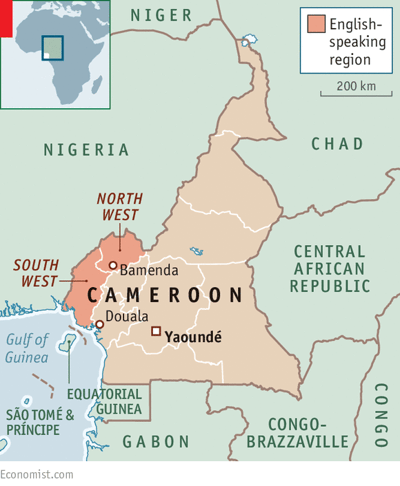
2. Life in Bamenda: Growing Up as an Anglophone in Cameroon
In looking at Christopher’s story, it is important to first understand the history of the political division between Anglophones and Francophones. Francophones being the majority of Cameroon and largely in control of the government, finance, and business, hold far greater power than the Anglophones, leaving them to be marginalized in their own country. This has been the case since the 1960s when the then-country called Southern Cameroon became part of Cameroon. Bamenda, where Christopher was born and raised in an Anglophone majority area. Having been born around the same time when these political upheavals were occurring, he was able to see how the tension between the two linguistic groups had built up over the years.
Being born as the eldest among 7 children, he grew up to be rather an ambitious and independent person who liked reading books and performing well in his academics. He also was born into a well-off family with his father working in a government treasury, which later gave Christopher the opportunity to work in the same position. However, he states that an Anglophone working at a government entity is “almost impossible now.” In the 1960s when he was born, the oppression from the Francophones was not as severe. Cameroon used to have a federal system where the government consisted of two separate governments, Anglophones and Francophones each having their own governments within the same state. In 1972, Cameroon became a unitary state and was renamed the United Republic of Cameroon, ultimately becoming the Republic of Cameroon in 1984 under prime minister Paul Biya. Calmly but also showing slight distress in describing the history, he briefly touches on the discrimination he had personally faced during his college life.
3. Timeline Comparison of Cameroon and Christopher
| Situation in Cameroon [Learn more…] | Fon Fon Christopher | |
|---|---|---|
| 1960s | Southern Cameroons (Anglophones) voted to join with the Republic of Cameroon to form the Federal Republic of Cameroon | Born in Bamenda (Anglophone part of the country) |
| 1970s | Cameroon becomes a unitary state following a national referendum and is renamed the United Republic of Cameroon | Goes to college in Yaounde and faces discrimination from the Francophones |
| 1980s | Prime Minister Paul Biya succeeds President Ahidjo, who resigns- Cameroon goes through an economic crisis until the early 2000s | Starts working at the government for 26 years- Economic crisis meant that the workers were not getting paid properly |
| 1990s | Government starts privatizing corporations in order to open up African economies to promote private sector development | Creates a trade union in order to protect workers’ right |
| 2000s | Growing tension between government and separatists lobbying on behalf of the country’s five million English-speakers [Anglophone Crisis today] | Succeeds in starting his Anglophones union, leading to his persecution by the government |
4. The Privatization Issue in Cameroon: Working in the Government and His Creation of a Trade Union
“I saw that what they were doing was not good. The government was acting weird. So, I decided with my influence, to create a union.”
According to a research paper written by Piet Konings, privatization in Cameroon has become a key instrument in the stabilization and structural adjustment programs imposed on Africa by the Bretton Woods institutions. “It is an essential part of an overall strategy to open up African economies to market forces and promote private sector development.” The governments in Africa are under international pressure to sell public enterprises to domestic and foreign private capital. African governments were forced to go through privatization as a condition of them receiving international aid that the ruling Francophone movement needed for their political survival.
At this time, Christopher – after majoring in computer software engineering in college – started working in the government in computer and treasure accounting. Specifically, he was working with the National Water Corporation as the head of the computer department. Parastatal as he explains, is a term used to describe a company or organization which is owned by the country’s government, often having some political power. What he faced working in this parastatal company was unfair treatment of workers and even failure to properly pay salaries for three years. In response to this situation, the government started privatizing the National Water Corporation w was eventually sold to a Moroccan company.
However, as Christopher later explains, the process of privatization further deteriorated the workers’ conditions. For Christopher, forming a trade union was one way to protect the local Cameroonian workers in the face of international and governmental pressure.
Being the head of the computer department, Christopher and one of his colleagues had a huge influence which made it possible for them to gather people in creating a big enough union that later impacted the presidency and national assembly. Approximately 1000-1200 members were recruited as part of this activism. He organized multiple rallies and strikes which made the Cameroonian government feel threatened.
While it was not illegal to form a trade union, the effort to unionize was right away seen as an impediment to the market reforms that the government was attempting. As the leader of this union, Christopher was the natural target of the government.
Christopher, hoping to make a change decided to create a trade union in an attempt to protect workers’ rights which is what made him come off as being the enemy of the government.
One day, after a meeting that was held between the trade union and the government, his colleague president was found dead.
“My colleague president was found dead and we don’t understand how he died, my colleague president… so that was what actually made me want to run because we had been threatened.”

During the economic crisis [Learn more…], there were rumors among the Anglophones that Paul Biya was trying to privatize the Cameroon Development Corporation (CDC) to sell it to Francophone enterprises. It was by far the oldest and largest agro-industrial parastatal that is located mainly in the coastal areas of Cameroon and contributed hugely to the local Anglophone economy. Privatization of this corporation, which represented the Anglophones’ cultural and economic heritage by the Francophone majority government, hugely raised the tension between the two linguistic groups. Christopher, seemingly disregarding the great personal risk he was already facing from organizing the National Water Corporation, began working to organize the workers of the CDC.
Multiple rallies and strikes were organized by Christopher in voicing their sentiment of unfair treatment. However, every time they did, they were warned by the government and were violated multiple times. Their voice was oppressed by physical force.
5. Persecution by the Government and His Decision to Leave Cameroon
“We were beaten quite often, we were taken to the police, they will beat us and tell us we are doing the strike, beat us and set us back, so that’s what they do with us so really that’s it.”
The CDC union was created in 2002, the first strike was organized in 2008 and his colleague was found murdered in 2012. During this long-held activism, Christopher was locked up once, received countless threatening tapes and calls, and was beaten multiple times by the police. Every time they organized rallies; they were told not to do so.
“It was hard, but I decided that it was better for my family if they don’t see me. It is good for me to be alive than to be there and die and the family dies.”
He received a call from his wife, saying that the government is pursuing him and that he needs to leave Cameroon right away. Leaving his family behind was a tremendously hard decision but he knew this decision was better for his family’s safety. As a leader of the trade union, he had connections with the civil society organization, which gave him the chance to come to Japan as a delegate for a conference. He immediately took the opportunity. The process of getting prepared took around a month, while he was still being targeted by the government. Luckily, his uncle is a policeman and so Christopher was able to ask for his help in safely getting to the airport.
Going against the government, political refugees not only risk their life, but they also face the pressure to leave their families behind in need to protect their life, too. Abandonment of all relationships, ways of life, and connections to those left behind. Being a refugee is not solely about fleeing a country but rather the long-term hardship of going through both the mental and physical pain is separation and isolation.
Looking at what Christopher had been through, the experience with the Water Works Corporation, he knew that he was already a target of this government. He has been repeatedly warned and even threatened. And yet, he went forward to attempt to unionize the CDC. There was no way that he could not be unaware that his actions would have displaced his own movement, and he was clearly putting his own life in danger. This appears to be the sort of self-sacrificing, even a heroic act. When presented with this characterization — of him as a hero — Christopher brushes it off. However, he says in the interview that he honestly did not expect the government to react this way. “It was from my own heart,” he explained just because it was so obvious that people were being exploited by both the government and then the privatized enterprises. He said that he “simply made actions because people around him were suffering.” In particular, he valued hugely how important it is to give voice to the truth. He states that even if he had been aware of the personal risk he was taking — even to his life — he would have still done the same thing. In the end, he finished the interview by saying, “I believe that if all of us could unite and think well, this life would be sweeter for all of us.”
