

1. Work
1.1. Nahed’s Legal Status in Japan
Nahed arrived in Japan on April 24th, 2018 on a tourist visa. After two weeks, she changed the visa to Designated Activities, which is a status given to asylum seekers who are in the process of refugee application to gain the Status of Residence. People with designated activities are allowed to work only after 6 months, but Nahed’s savings ran out after the first two months in Japan.
As Nahed’s story illustrates, Japan is criticized for the lack of effective support for refugees. About 95 percent of refugees who come to Japan in order to receive refugee status are rejected. Instead, they are treated as asylum seekers who have Designated Activities like Nahed. The application process is very difficult for refugees because it requires a lot of paperwork and interviews with strict evaluation. This is problematic because they have no health insurance and housing during this period and thus no way to protect themselves.
“Be realistic!“
Nahed needed to apply for financial support from the Refugee Assistance Headquarters (RHQ). She was approved to receive eighty-five thousand yen per month, which is just enough to maintain minimum basic needs, such as rent and food.
Nahed describes this financial support system as unrealistic because the amount of money is not enough to have any social interaction with others. All she could do was remain at her house as she did not have any extra money to explore outside and meet people. Moreover, she mentions how difficult it was to maintain receiving support. She needed to report how much she spent on what, accounting for every single yen. Though she appreciated the financial support because it allowed her to survive, she decided that she would quit receiving the funds because this system meant that being social and becoming a part of communities was nearly impossible.
1.2. Nahed as a Worker in Japan
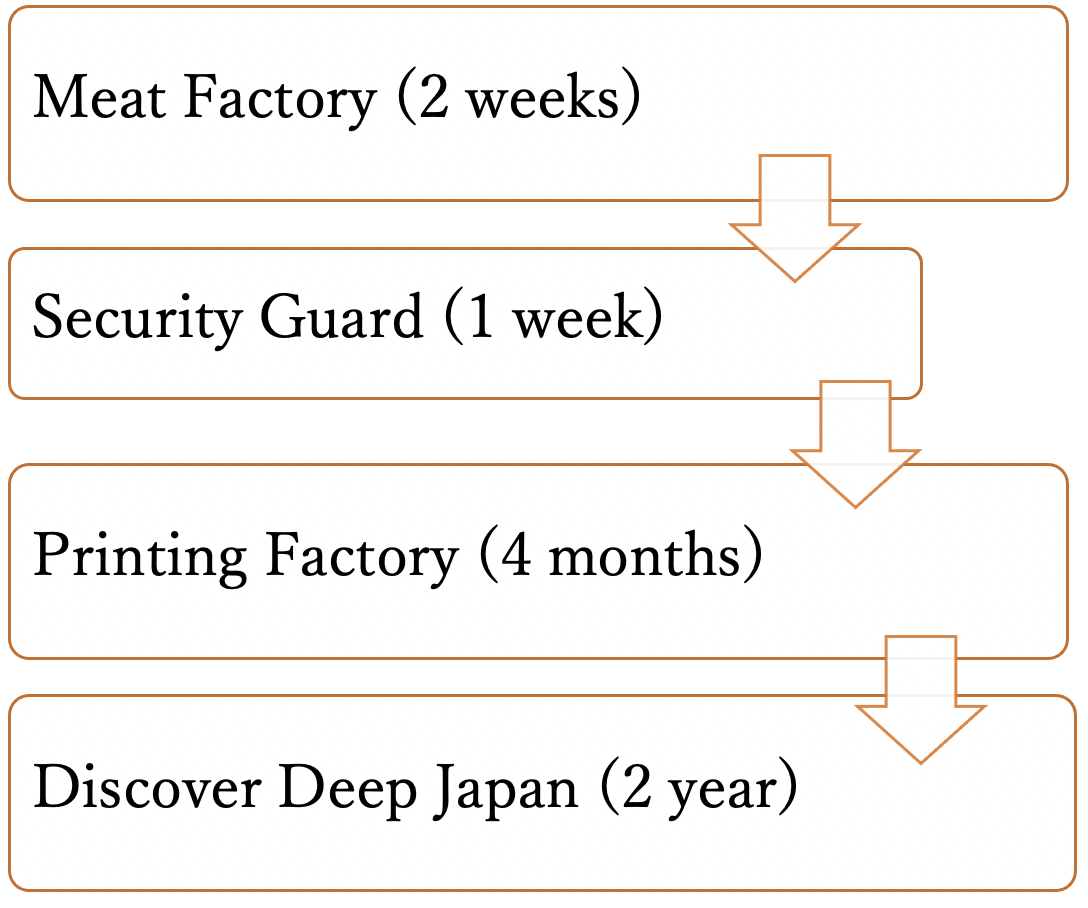
After Nahed stopped accepting financial support from RHQ, she immediately started working whatever jobs were available to her. Her first job in Japan was at a meat factory in Saitama. The job was introduced by one of the biggest refugee-supporting organizations, the Japan Association for Refugees (JAR). She says the boss and most co-workers welcomed her and she was comfortable adjusting to the new workplace since it was a very international community. However, the working conditions were very harsh. The job was usually done by men since it was very physically demanding to do. Her long commuting hours due to the location contributed to her exhaustion. She needed to take a two-hour train ride to get to the factory, and then work for the next eight hours cutting and packing meats in a very heavy food processing uniform.
“I was smelling chicken every day. I have to wash my clothes four times to not have any more of this smell. And I think sometimes it stays in my mind. So I was smelling chicken everywhere and didn’t like that.”
After working for three weeks, Nahed was able to save some money, so she set out to find a new job. She received one week of training to be a security guard in her new job, but she decided not to continue because the job was very irregular and the payment would have been unstable. After this, she was able to find a job at a printing factory in Saitama near her house. She found the job through Facebook. Even though she was the first and only foreigner in the factory, the working experience was very satisfying as her colleagues had a very respectful attitude towards her. Also, her work was packing books together, so it was not as physically demanding nor required a high level of Japanese language skills.
After four months of working there, she decided to change her job to work at Discover Deep Japan (DDJ) in Fukuoka because she knew it was a very rare opportunity for refugees to have a white-collar job as an office worker. DDJ was established in 2019 with a mission to improve communities and businesses in rural areas by providing digital marketing solutions. Moreover, they support refugees and immigrants by giving them a better environment as a worker and contributor in these areas.
The application process was very competitive in that four people out of 75 people were accepted through a process of three interviews. Nahed succeeded over the competition and was employed. She appreciates the stable income that she gained from the job and agrees with the mission that DDJ holds. However, because of the COVID-19 situation, many central activities to her job such as on-site reporting have been limited. So Nahed feels as though she has not been able to be productive and contribute important work as a member of the company.
“What is most important for me is to feel that I’m doing my best to provide the results. This makes me happy about working.”
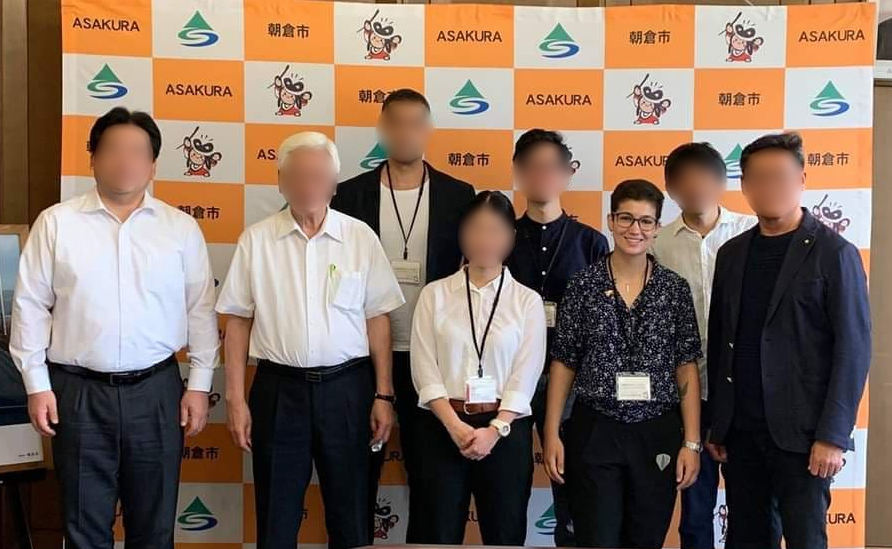

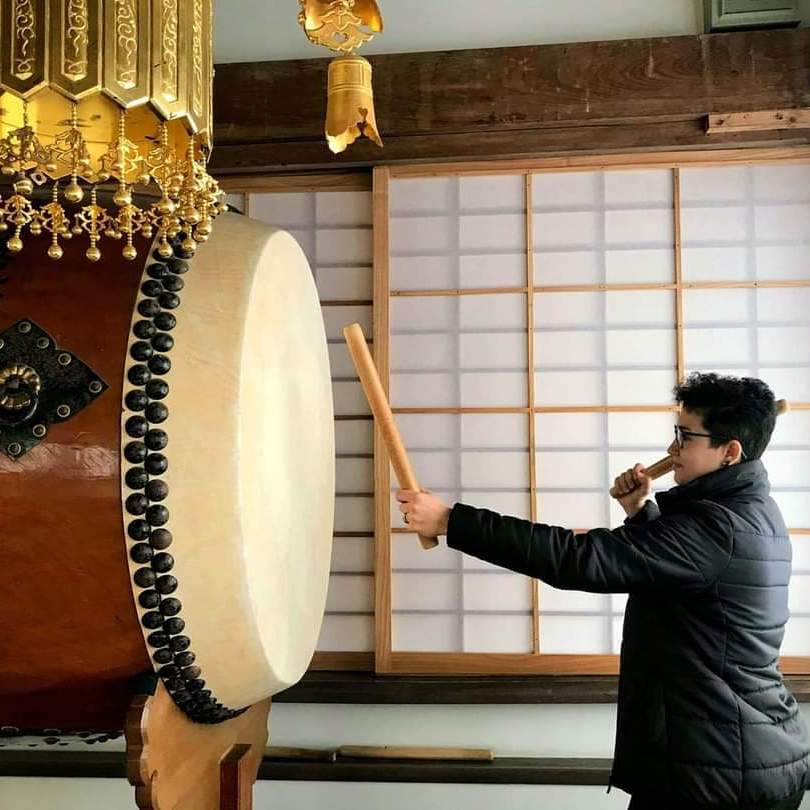
Right: Nahed teaching high school students about Tunisia
Nahed has never been one to shy away from honest work and she has tried to maintain herself as a responsible and respectful employee. She follows rules, keeps track of time, and works productively. She appreciates the opportunity to work because she enjoys and values learning new skills, so she recognizes that her working experience as a blue-collar worker was a valuable experience for her. However, she was more attracted to her current job as an officer in DDJ because her ability as a writer, a web designer, and a multi-language speaker allowed her to effectively contribute value to the work.
Overall, Nahed can be considered a success story among refugees in Japan when compared to the immense difficulties that many face after coming to the country. However, when she was asked to describe her current status as a worker, her answer was:
“It’s a good thing, but also I pay the price.”
Work is not only a means to make money. Work is also a way to connect one with other people, achieve one’s dream, and make a contribution to the larger society. In other words, work is very important for people to flourish in their lives in various ways. However, as Nahed’s story shows, it is difficult to maintain a work-life balance within the Japanese structured society that has limited support and opportunities. Despite the difficulties they face, many refugees still make an effort to live fulfilled, social lives. Their efforts should be met with the chance to have more opportunities to explore and show their potential and abilities.
Survival Strategies: Developing Your Skills

One constant in Nahed’s life is her dedication to developing her skills in order to succeed at work. Whether it be in journalism, website design, or factory work Nahed has consistently worked on developing her skill sets in order to complete her tasks with accuracy and efficiency. This strategy to develop skills is what has helped her maintain security in the knowledge that she would be able to succeed professionally no matter where she went. It also helped to cultivate a sense of pride and happiness in regards to doing a good job no matter where she was.
By pursuing a useful skill set which can aid in future professional pursuits, Nahed encourages others to put time into creating one of the few controllable pathways which could allow a person to feel high levels of confidence and continue to practice self development. This is the advice she gives to those who ask Nahed how they can build a better life for themself, in their home country or abroad.
Nahed has experienced extreme unpredictability throughout her life, and has learned that no matter how hard she tries, total control is simply impossible. However, she has found that one of the few things she could control is her skill level at her job. It was useful and helped her to feel fulfilled as an individual to show that she put effort and respect into her work. She highlights that unpredictability is something everyone experiences, so her advice is to find happiness through feeling successful.
1.3. Nahed as a Refugee in Japan
“Why will I see myself as a refugee?”
The image of a refugee is often discussed especially through the media as something negative: poor, miserable, incompetent, uneducated, and violent. Refugees, including Nahed, suffer from the judgment created by negative stereotypes and at times feel a loss in their dignity because they are refugees.
Nahed sees herself as a foreign worker rather than a refugee in Japan because she thinks she is contributing to Japanese society as any other Japanese person does without receiving any support from the government and other organizations. Moreover, she does not want to reveal herself as a refugee because she has experienced her ability and work being underestimated by the Japanese people. This is despite overcoming many challenges and making a lot of effort to achieve her skills and learnings throughout her life. Those achievements and efforts should be valued regardless of whatever status she has.
Nahed shares one of those negative experiences that she faced. When she was having a meeting with local Japanese people as a member of DDJ, her boss introduced her as a refugee to them. Then, Nahed noticed how the local people changed their attitude negatively after hearing that Nahed was a refugee.
2. Community
People need people. People build relationships with other people and belong to various communities to flourish in their lives. However, many refugees struggle to have a significant relationship because they are considered outsiders in their home countries and their host countries. In addition, Nahed’s story shows people’s expectations and values shared within a certain community make her uncomfortable belonging to a community. Nahed believes people should be more free and open-minded to acknowledge the pluralistic sides of people. Nahed sends an important message that people should be with people who can make them feel comfortable being who they are.
2.1. Community Before 2019
Nahed went to Tunisian schools and worked at several Tunisian companies. Until 2019 she had always been in a Tunisian-dominated community when in her home country. However, she was not in any religious communities due to her aversion to religious practices. She started being involved in the LGBTQ community after attending university by meeting fellow LGBTQ people and using online platforms to communicate.
When Nahed was in Korea in 2017, she was not able to make a significant community due to her demanding 12-hour shifts, 5 times a week at a pizza restaurant.
“I didn’t try to talk with other people and I didn’t have time because as I told you, my job (was very busy). And in the daytime, I was sleeping. And after that, I tried many jobs and (…) two weeks to organize everything and went to Japan. So I didn’t have even time to think about (other people).”
She did not participate in any religious or political communities. As for finding an LGBTQ community, she tried to find others online, but it was not very successful other than one Korean girl. To make a living in Korea, she needed to work at Korean companies. However, due to the language barrier and negative stereotypes that Korean workers have against foreigners, Nahed was treated as an outsider. Even though most workers were Korean, she was able to meet some other refugees. Also, she shared rooms with other refugees in the first few months. However, she did not build a significant relationship with them. However, she was able to build a significant friendship with a Tunisian man who helped her a lot to survive in Korea.
Nahed came to Japan in April 2018. She was temporarily involved in some Tunisian communities. She met fellow Tunisian people in the street, but they forced her to follow their religious beliefs, so she stopped interacting with them. Nahed then found a Tunisian community in the Tunisian political party in Japan. Nahed occasionally participated in the meetings as a significant member and participated in political activities. However, she also distanced herself from these political activities after becoming disenchanted with the cause. She could no longer see how the political party was going to be able to help Tunisians. Other than Tunisian communities, she attempted to create an LGBTQ community by visiting various gay bars. Nahed was also part of the refugee community since she received support from JAR, such as having consultations and participating in Japanese lessons. Moreover, she met some refugees in her workplaces, but the relationship did not develop into a significant one. Even though she is in Japan, it was hard to actively be involved in the Japanese community because of the language barrier, so her only interaction with Japanese was at her workplace.
Overall, she faced many difficulties in finding a community that let her maintain her identity as a political, non-religious, and LGBTQ person. Also, after she became a refugee, she needed to deal with a demanding professional environment that required her to work all day, so her social interaction was limited. Her experience of living abroad was difficult in general because of the language barrier, cultural differences, and the existence of negative stereotypes. Even though she became a refugee to live authentically, being a refugee has become another restriction to being who she is.
2.2. Community After 2019 in Fukuoka and COVID-19
“I have no one.”
Nahed arrived in Fukuoka in August 2019, already during the COVID-19 pandemic. Fortunately, she did not struggle financially and was able to gain some help from the government, local organizations, and her workplace. However, she experienced mental health problems due to the COVID-19 pandemic because she needed to deal with the fear of uncertainty caused by the changed employment trends and global situation. Moreover, she felt extremely isolated due to the limited social interaction that she could have during the pandemic. In addition, where she lives is a very rural area in Fukuoka, so it also restricts her from conversing with people. It shows how much she values social interactions with others.
Survival Strategies: Resolve in the Face of Adversity

Nahed is no stranger to adversity and has faced a multitude of challenges throughout her lifetime not only through her experiences with persecution but also with general life obstacles that many people can relate to. Keeping a strong mentality that compartmentalizes past traumas while also focusing on self-care to improve current mental health is how Nahed keeps moving forward in her life effectively. Though she recognizes that she has experienced extremely dangerous or even life-threatening experiences that the average person would never understand, she still recognizes that declining mental health is something that affects everyone.
For Nahed, moving to Japan is not an all-encompassing solution, just like for every refugee going to a new country is not an all-encompassing solution. Past trauma, a lack of self-care, and declining mental health have lasting effects regardless of the environment one is in. The COVID-19 pandemic and the isolation that resulted from it made Nahed more proactive in exercising her survival strategy to take care of her mental health. This is another example that shows how survival strategies are not only applicable in times of persecution but can carry through as useful skills throughout life.
2.3. Tunisian Community
“There are more problems than benefits.”
Nahed intentionally avoids belonging to any other Tunisian community. When she was in Saitama in 2018, she experienced some Tunisian men forcing her to pray.
“They (Tunisian men) one time they wanted to force me to go to pray and I was disappointed about it (…) And they repeated that three or four times.”
It reinforces her thoughts that many Tunisian people expect a Tunisian to be a Muslim by practicing religion and following gender roles regardless of location. She does not want to continue experiencing oppression against who she is because that was the entire reason for her becoming a refugee and leaving her home country.
“They are my family.”
However, she maintains her significant relationship with three Tunisian friends that she knew before coming to Japan. Nahed described her friendship community with her old Tunisian friends as family. They are very different people with different values: different jobs, different sexual orientations, different genders, different living environments, and different religious beliefs. This shows her core community is not based on a certain category rather they are connected with something more fundamental like a family. Nahed describes how they are respectful and nonjudgemental to each other. These attitudes allow them to have a deep relationship.
2.4. LGBTQ Community
“I like girls. That’s all.”
Nahed does not belong to any LGBTQ community in Fukuoka even though she wants to. She does not have much opportunity to interact with LGBTQ people because of the inaccessibility to gay bars and because of the excluded and small Japanese LGBTQ community. Nahed explains that the LGBTQ people in Japan are hiding and points out that Japanese society is also not very open or accepting of diverse sexual orientations.
Most importantly, Nahed shares her concern that the current LGBTQ community and movement are becoming like a trend and fashion. Belonging to the LGBTQ community is very challenging. It still has various serious problems and individuals face many difficulties and stereotypes. Even though it is an essential movement for LGBTQ people’s rights and lives, people underestimate the seriousness.
Furthermore, Nahed points out that the LGBTQ community is categorizing people by putting names and definitions for each sexual orientation, such as straight, transsexual, and bisexual. She thinks what people need is not a name to define themselves, but what they need is the right and freedom to meet and build a significant relationship with whomever they want. Also, the label can limit who one is because others tend to have a certain stereotype with the name and one will also internalize what other people think.
2.5. Japanese Community
“Fitting in the box.”
Nahed does not belong to any Japanese community other than her workplace in Fukuoka. She moved to Fukuoka during the COVID-19 pandemic, which caused her to have limited interaction with Japanese people even though she is living in Japan. Also, the language barrier limits her to build significant relationships with Japanese people. Furthermore, she notes that while many Japanese are not discriminatory towards foreigners it is not particularly easy for her to build these relationships because they tend to be exclusive and less open to differences and new changes.
Nahed shares this story to show that many Japanese individuals hold similar values and thoughts because Japan usually enforces strict rules and particular directions to follow. While she acknowledges the importance of those rules, she emphasizes the importance of having the freedom to think and act. She brings up the important idea that “fitting in the box” will limit people’s potential and opportunities.
Survival Strategies: Exercise Your Agency to Move

Moving is an essential factor in what it means to be a refugee. One is facing the threat of death due to the severity of the persecution they face and is forced to move to new locations in search of safety and the right to a better quality of life. Moving has been a major theme throughout Nahed’s past experiences as a refugee, and is tied to the survival strategy which is most important to her: Exercising your right to move.
Nahed’s independence and belief in exercising her agency is expressed again, this time through her will to change her environment. This will extend further for her, becoming a deep responsibility as she points out that she is the only one who can allow herself to live authentically. Therefore, it becomes her responsibility to find a place where she can thrive and take the next steps in her life. This idea of being responsible for your environment is a survival strategy that she extends as a call to action for everyone around her as well.
In a world that is constantly changing, constantly bringing forward new challenges it can seem daunting to try and control everything in life. Nahed stresses that one of the few things one has agency over is the right to move. Being born in a particular country will always be out of a person’s hands, but if they feel like they do not belong there they can find real happiness and new opportunities by changing the living environment. This change allows them, just like Nahed, to live openly and authentically.
