This memory was one of Nahed Belkiria’s first examples of what could happen to people in Tunisia who did not feel as though they fit in with the social standard of the country. This experience with a boy who also questions his sexuality left a lasting impression on Nahed. It would even later mirror her own path through declining mental health and eventual thoughts of taking her own life. Examples of punishment, isolation, and violence continued throughout her years growing up and eventually attending university in the country.
Nahed is a Tunisian woman who endeavors to live her life with freedom and dignity. However, her path has never been easy as a citizen of a politically and economically corrupt country, especially as a non-religious person in a society where people are expected at least to act religiously, and as a woman who is LGBTQ. One of the serious problems is her family denying and refusing to accept Nahed’s sexual orientation. Neither her mother, father, sister, or brother communicated openly with her or expressed any support for Nahed. This resulted in a tense home life which left her completely isolated. With this wall of silence at home and constant harassment in public, Nahed faced dangers nearly constantly.
At the age of 28, she had to become a refugee in order to survive. Her choice allowed her to leave the harmful environment, but it did not make her life any easier. She needed to jump into and survive in new environments without knowing their language and culture. She faced challenges like the lack of government support, discrimination, a harsh working environment, negative stereotypes of being a refugee, and social isolation due to COVID-19.
Even though there are many obstacles, Nahed lives very powerfully without giving up. Nahed finished her master’s degree in contemporary French literature. Using this education, Nahed was able to author multiple fiction novels, usually derived from personal experiences. This ability to write became an outlet for emotions connected to her experiences as a gay woman and also a creative way to bring attention to social issues she found important.

She always tries to be a contributive and dutiful worker no matter what kind of job it is. Currently, she does office work under a designated activities visa in Fukuoka, Japan by winning a very competitive job interview process. Nahed has been able to fight and overcome many problems with her rational and critical thinking which allows her to see the bigger picture and make a better choice for her.
1. The Tunisian Revolution

The Tunisian Revolution was the first domino in a series of subsequent Arab Spring revolutions that spread throughout the Middle East in the 2010s. Following the public demonstration of Mohammad Bouazizi who lit himself on fire on December 17th, 2010, the city of Sidi Bouzid erupted in protest against the political corruption throughout Tunisia. This movement spread throughout the country with hundreds calling for a change in power. The current government was essentially a tyranny under President Zine al-Abidine Ben Ali.
The political landscape of Tunisia at the time was riddled with corruption at all levels. There were systems of bribery, preferential treatment to those of certain social status or positions, and general discrimination at the decree of government officials. Nahed recounts the inequality of these structures, which targeted those without money or power including herself.
Though her family was comfortable enough to afford a comfortable home and higher education for all members, the effects of this corruption were not lost on Nahed. She felt this corruption’s destabilizing effects on the lives of those around her.

As protests continued across the country, hundreds were detained and killed, in particular many young Tunisians who made up the majority of protestors. Many businesses closed or were destroyed as people took to the streets, therefore affecting many people’s ability to get jobs or maintain an income. Services such as public transportation were at a standstill which greatly affected Nahed. At this time she was attending university while living in her family home. With no transport options and minimal support from family members, Nahed feared that she might not be able to finish her studies, which was important to her. In order to find a better living situation that allowed her to escape a difficult home life as well as find a person who could drive her to school, Nahed made the decision to enter a marriage arrangement with a man.
“When the Arab Spring started in Tunisia, he actually helped me a lot. Without him, I would not be able to finish my master’s degree because, at the time, even transportation, everything is broken. So it was like every day we can meet at the university and go to work.”
It is clear that the events of the Tunisian Revolution directly affected Nahed’s life trajectory. They pushed her into even more vulnerable positions and resulted in her relying on others for help.
Eventually, President Ben Ali was forced to flee, and 2011 saw great political instability in Tunisia as its government attempted to regain control of itself. Though Tunisians thought that this revolution would bring positive change and greater equality, the lasting effects seen 10 years on are not so promising. One-third of Tunisians are unemployed, voter turnout is lower than ever at 42% as of 2019, and power struggles at the presidential level are threatening to lead to an all-out coup. This serves to show that the issues of corruption and distrust that plagued Tunisia have only strengthened and Nahed’s sentiments on the relationship between respect and money in Tunisia still stand.
2. Tunisia & Muslim Identity
As of 2020, 99% of Tunisia identifies as Sunni Muslim. This overwhelming majority follows the customs of religious holidays such as Ramadan, certain codes of behavior such as abstaining from consuming pork or alcohol, and often attending prayer services that worship Allah (God). Even the constitution confirms that Islam is the main religion of the country. This means that an extreme minority of the population, only 1%, either practices another religion or does not practice at all. Nahed was one of this minority, opposed to the practices of Islam.
She found that because she resisted in joining in on performing the customs as a Muslim she was singled out as a ‘bad person’. It did not matter if she performed well at her job or showed a positive moral code, without religion Nahed was seen as an outlier and a target. This type of social reprimand is experienced by many others in Tunisia who are not outwardly religious and even leads to many who perform the expected customs in order to avoid sanctioning.
This targeting is especially prevalent because Nahed is a woman. Though stereotypes of how women are treated in Islam are harmful and women can have a broad spectrum of experiences as a Muslim, Nahed felt many onerous expectations. Many assumed she would be happy to attend prayer with them, and became concerned and even angry when she refused to go. She felt immense pressure from her mother to follow expected gender constructs for girls in Tunisia, namely avoiding parties as a young person which could compromise her integrity as a virginal woman. Nahed felt pressure to follow the expected life path of marriage to a man, and a quiet life supporting the household. As Nahed explains, many women who do not conform to the ascribed Muslim expectations in Middle Eastern countries such as Tunisia face great discrimination and violence.
3. Attitudes Towards LGBTQIA+
As a woman, Nahed already faced threats and harassment in public spaces as so many other women in Tunisia do (click here to see testimonials from Tunisian women). Nahed observed many young men around her attack and criticize women around them, and recognizes that the root of the issue could be coming from the anger from rejection. Her experiences with persecution by young men in public areas are one of the many layers to the complex dangers that surround Nahed, however, as a woman who identified as part of the LGBTQIA+ community, Nahed faced a greater level of persecution.
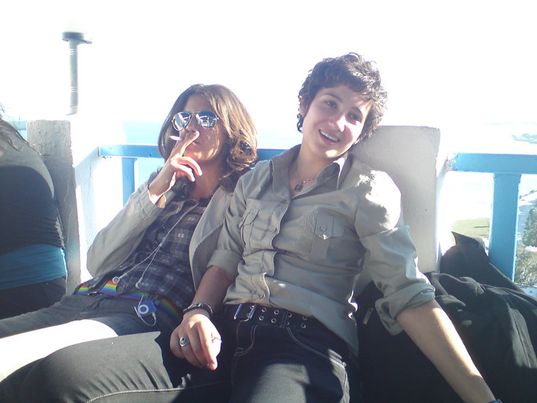
Article 230 in Tunisia’s penal code criminalizes being gay and this law is used by police and the government to systematically target LGBTQ people, organizations, and activists. According to this 2021 report on discrimination based on sexual orientation in Tunisia, there are multiple facets to the ways in which gay people feel persecution. Social exclusion occurs when gay people are isolated as the ‘other’ in Tunisian society, and these divisions deepen as stereotypes are used against one another.
This exclusion can result in other issues for the LGBTQIA+ community such as the lack of medical care due to distrust in doctors as well as lack of education due to bullying in school. Though Nahed faced bullying in school, she was able to finish not only high school but also college education. As she moved forward into the professional world, Nahed then began to face workplace discrimination as well as unstable living situations that came from being fired. As LGBTQIA+ people enter adulthood, new challenges with workplace discrimination and unstable sources of income culminate, and Nahed describes, a lack of ability to create a stable adulthood.
However, perhaps the most immediate, unpredictable threats came to Nahed through situations stemming from institutional violence and encountering hate speech from others in public. Those threats are a common problem for many throughout Tunisia, and Nahed highlights the experiences of not just herself as a gay woman but also gay men who dress femininely.
“It’s important to keep in mind that LGBT people are not all the same.”
Nahed recognizes that her experiences are one particular sphere of the LGBTQ experiences in Tunisia. Though the facets of her life are not universal to all gay Tunisians, it is still important to learn more about her persecution and what she did to overcome it in order to better understand the root causes of some of the problems this population faces.
Nahed also exemplifies this deviation from the expected through her journey as a refugee. Her experiences which ultimately brought her to Japan provide a unique example of the trajectory of persecution, finding asylum, to building a new life.
