In the midst of persecution and terror, Sana was forced to sacrifice his studies and career to support his sick parents. While only in his mid-20s, he was at the height of his advocacy for social change within Ghana and deep into Developmental Studies at university. Despite the violent backlash, Sana was in his prime and progressing through his activism and education. However, he also had a very close relationship with his parents so he, therefore, always felt obligated to be there for them no matter the consequences. Unfortunately, this also put his parents and other family members in danger, as he was still being targeted for his activism. As the terrorism had gotten worse, his parents decided that he would flee to Japan, where he would eventually attempt to remain permanently. His expectations of Japan were met with a harsh reality. Things took a turn for the worse when he realized he could not be accepted for refugee status, left with an ultimatum to either be detained or deported back to his country where he would be at risk of irreparable harm for his political activity and opinion.
1. A Target on His Back
1.1. Taking Care of Parents
Sana had to look after his mother who had suffered a heart attack, and his father who had diabetes and had recently had a stroke. He remembers the time, saying “It was so difficult. And most of my siblings, they, they went far away. Some were married, some also went far away out of the country…I decided just to take that tax and also follow them to Burkina to assist them.” Taking care of his parents reflected how dedicated he was to his parents, since he left his studies and activism behind, devoting all his time to them. This ‘tax’ was something Sana was obligated to take, as it is expected to honor your parents within the Muslim religion, but also, for the love and devotion he had for them. Therefore, he was willing to quit all his progress in developmental studies and social advocacy that he was passionate about.
Mostly on his own, Sana had many responsibilities like ensuring his parents had taken their medications daily, and providing them adequate healthcare. Unfortunately, due to an increase in war and violence, the quality of healthcare within Burkina Faso has decreased significantly due to a lack of financial means. According to the World Health Organisation, the escalation of the conflict as well as the lack of financial investment in Burkina Faso’s healthcare system significantly affected its people including Sana’s parents to access adequate medical attention; although there were some efforts to improve the system, there was only less than one physician per 10,000 people and they were usually underpaid.
Wanting the best for his parents, he was forced to travel to Ghana every month, which was expensive and significantly dangerous. There was a big possibility that he could be attacked by opposing tribes along the way, along with the threat of terrorism. As a result, Sana and his parents were no longer allowed to return to his father’s homes in Ghana, which made the event of traveling even more challenging, having nowhere to stay for long-term visits to Ghana. Furthermore, having to never return to these properties was also like an erasure of memories. His family was slowly losing the things most dear to them. To avoid danger, Sana would take his parents a longer route (red path), as opposed to the usual way (green path), which passes through the area linking Ghana and Togo.
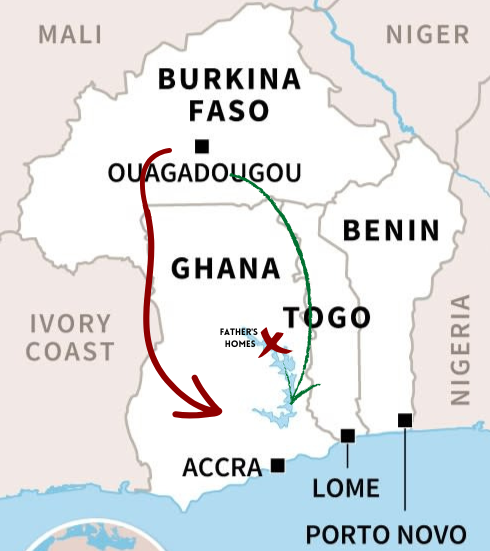
“We prefer to be safe [and away from] where we are targeted.”
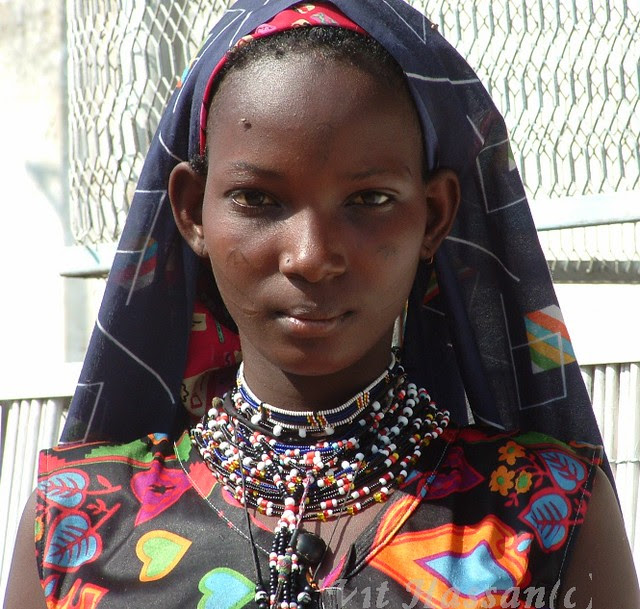
On the (green) route, many people, especially from Sana’s community, are attacked because of differences in their tribe and religion. In his community, everyone is of the Mossi Tribe, and is either Christian or Muslim, with tribal marks on their stomachs. Therefore, Sana and his parents are easily identifiable as outsiders, since the opposing tribes they have to encounter in the Bawku area are either Fulani or Kusasis, with tribal marks on their faces. Tribal marks are used for a number of reasons in Ghana, and other African countries for a number of reasons, such as identification, spiritual protection, and medicinal purposes. Walking this route meant there was a possibility of getting shot from a distance and killed instantly.
The thought of facing death, whilst having the responsibility of his sick parents took a toll on Sana’s mental and physical health. However, being a devoted son, he would do whatever it took to make sure his parents received the best care, disregarding the expense it would have on him. Sana ultimately persevered with this huge obligation and never gave up, despite all the risks and threats he may have had to face along the way.
1.2. Dangers of Staying in Burkina Faso
“We are trying to educate people not to also follow like their kind of life. And they hated us because of that.”
Sana put his family at risk by remaining in Burkina Faso. Specifically, male family members would be caught in the crossfire, with the terrorists (Jihadis) attempting to find Sana’s whereabouts and put his activism to a halt: “We are trying to educate people not to also follow like their kind of life. And they hated us because of that.” Being actively targeted by the terrorists, Sana’s uncles and brothers faced their houses and businesses being destroyed or burnt down. But terrorism is not an unusual sight in West Africa; it has become a major issue affecting countless civilians including Sana’s family. In Burkina Faso, 1.7 million people, including almost 900,000 children, are internally displaced due to violence as of September 2022. As men are mostly targeted, family members who are dependent on their fathers and counterparts are unable to meet their basic needs such as access to markets and fields, adequate healthcare, and food security.

Furthermore, obtaining weapons in countries of West Africa is not that difficult due to the firearms trafficking market. Even the police and state forces fear the size of the market. Sana explains, “I don’t know whether they were supported by the Western part or even now some people are saying like, just supported by Russia, we don’t even know…they have even the military, like, they’re even scared of them. So it’s so difficult.” Sana’s concerns could relate to the presence of Russian influence in Burkina Faso; for example, the Wagner Group has been said to “fuel” terrorism in Africa. They have been accused of mass atrocities, torture, summary executions, and other brutal crimes whilst in African countries. This made it extremely hard for law enforcement to protect Sana from these terrorist groups since they were up against powerful opposition. This lack of protection and security would make living difficult for those of Sana’s family who still remain in Ghana and Burkina Faso. Even after Sana had fled the county, his family members were still being interrogated for his whereabouts.
2. Saying Goodbye
2.1. Leaving Family
“I was not so happy to leave them behind. So I cried almost three days before I agreed to move.”
It was extremely difficult for Sana to leave his family and move to Japan. He had a close relationship with his parents and it was important for him to make sure they were safe. What was especially hard for him was leaving his mother, whom he cared deeply for being her youngest child. From a young age, he always stuck by her, whether she was working on the road, or at home cooking with his aunties. As his mother’s health declined, Sana was still there to help. This was an unbreakable bond that he was forced to let go of in order to protect himself and his family. This was especially the case with his mother, whom he had accompanied to appointments, traveled with, and spent a lot of time together throughout his life. Of course, he did not want to leave his parents. However, they organized the plan for him as it was the only option at this desperate time.
They arranged for him to enter Japan with a business visa, where he would attend a conference on behalf of his aunt and stay there for a couple of weeks, with the intention of possibly getting a visa extension. As difficult as this move was, Sana was assured that his parents would be taken care of by his auntie and other family members. To avoid being caught, Sana secretly left Burkina Faso in the middle of the night for Japan, transiting through Morocco, which approximately took over 20 hours. It was bittersweet, mixed with a sense of long-awaited freedom from persecution and a sense of uncertainty about the safety of his beloved family that he had just been separated from.
3. Next Stop: Japan
3.1. Being Stopped by the Police
“It was like we are criminals or something… We were so worried and we were scared. So that day, we were saying ‘So Japan is like this.’”
Upon arriving in Japan, Sana had his own image of what Japan was like, and how the people would be. As a child, Sana was interested in the high-quality products his father would buy, like new watches and his motorbike. Realizing they were Japanese products, Sana was intrigued by Japan’s global image, which led him to research the country and wonder how peaceful it is to live there, in a state that has renounced war. He fell in love with traditional Japan and the idea of one day settling there, with a wife and children, in the same respect as how his father brought him up: with morals and an open heart. This opposed his siblings, who decided to flee to Western countries in Europe and America. With the situation he was facing in Burkina Faso and Ghana, Japan was perceived as a country with all the qualities he yearned for – peace, harmony, and space for opportunity.
With such optimistic expectations of Japan, it came as a shock when Sana experienced a different reality a couple of days after arriving. Sana, along with other foreigners whom he had met at the airport, had gotten lost in Yokohama after a business conference. This attracted the attention of police, who stopped and searched them, demanding to see ID documents, checking their belongings, and questioning where they were from and what they were doing. Comparing themselves with drunk Japanese people on the same street who were paid no attention by the police, they felt like they were racially profiled. Sana explains, “Did we do something wrong? They didn’t say anything…They didn’t show us where to go. So I lost just hope [in Japan].” Racial profiling in Japan is common, but it is often glossed over. Foreigners or people who look of foreign descent, particularly of Latin American, African, and Middle Eastern ethnicities, are usually victims of this, receiving abusive language, body checks, and other unjust actions by authorities. In fact, the Japanese National Police Agency admitted there were inappropriate cases of stopping and questioning foreigners for “driving a car” or “having dreadlocks” in 2021.
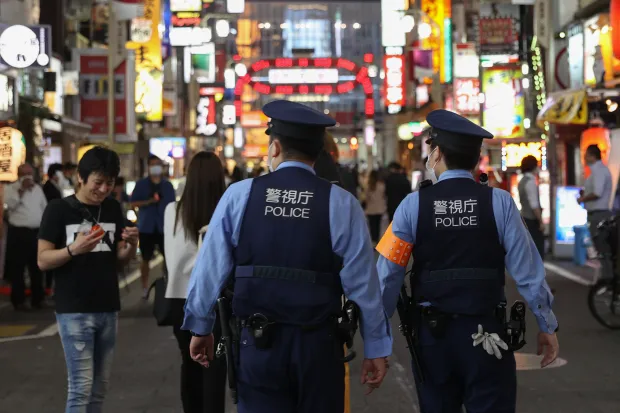
This sort of treatment invoked fear in Sana and his friends, worrying that they could get deported back to their countries for no apparent reason, as they caused no trouble and were simply just walking around. This heavily affected Sana’s opinion on how he once perceived Japan, and his trust in the Japanese government; this discrimination opened his eyes to how Japan may not be as peaceful as he thought when he initially decided to come to Japan. His trust was shattered, and a feeling of uncertainty and fear which was relieved after he left Burkina Faso, had crept back into his life.
4. To Be or Not to Be (a Refugee)
4.1. Deciding to Remain in Japan
“They broke into the family house, also her shop, and my father’s business. They burned it down.”
After two weeks of being in Japan, Sana received a call from his auntie, telling him that he “shouldn’t think about even coming home.” Sana continues, “No matter what happened, my parents said they’re okay and they’re praying for me, so I should just stay.” His father’s businesses were being burned down and his homes were being broken into in search of Sana. It was at this point in Sana’s journey that things took a turn; he had only one option left, which was to remain in Japan without the possibility of a safe return to Burkina Faso or Ghana. With strong faith that his parents and other family members would be safe, Sana decided to not return no matter the circumstances.
At this time, Sana was not aware that he was able to seek asylum. Luckily, a fellow friend from Ghana who was trying to get refugee status helped him with the application process. With the help of a volunteer, they managed to translate his application and send the relevant documents. On September 9th, 2019, Sana decided to apply for refugee status and was granted a two-month provisional stay. Sana explains the process, “I didn’t just feel like a refugee…it was just the paperwork.” This realization gave Sana a different perspective of his place; despite fleeing from persecution in his country, he had not felt like a refugee but instead a normal immigrant to Japan. However, the pile of documents with letters, photos, and newspapers that were needed to prove his situation opened his eyes to the fact that his status in Japan was different from an immigrant.

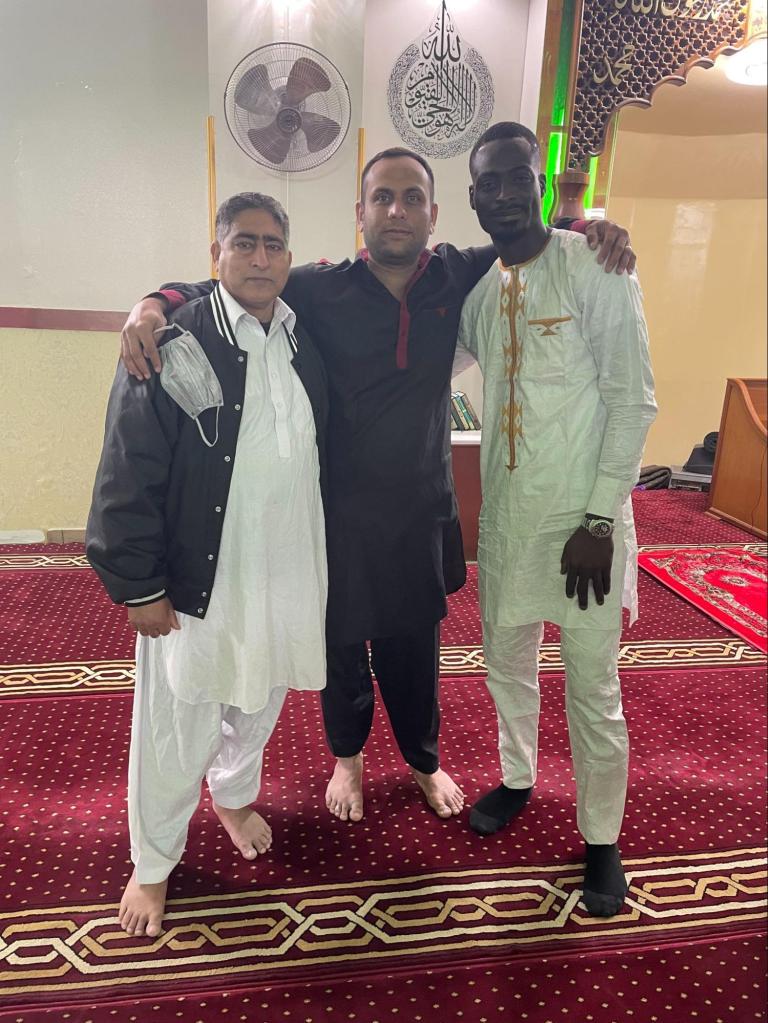
At this time, Sana developed aspirations of what he wanted to achieve whilst living here: making the best out of a bad situation of not being able to return to his country. He had dreams of teaching English and studying the Japanese language. However, due to his temporary status, he was not able to work or have access to national health insurance. Nevertheless, he managed to receive money and food support from the Muslim community in Japan where he met people from Ghana and the friends he had made during his short time of being here. Things began to look promising as he started to connect with others during his provisional period, with hopes that he would be granted refugee status and eventually establish a life in Japan, safely away from any threat of terrorism.
4.2. Adapting to Japanese Life
During those two months of his provisional stay, Sana stayed with his friend from Ghana. He told us the story of how difficult it was to adapt to Japan. He would often get lost and struggle to communicate with others due to the language barrier. It was not like back in his country where people would offer help to strangers by giving them support and helping them get home if they were lost in the area. This difference in culture made Sana realize that Japan does not exactly meet the expectations he initially had – the idea that all people are kind and peaceful.
The friend he was staying with during this time often guided him on what he should do when in need and how he should adapt to Japanese life. This was a huge relief, compared to his early experiences with others in Japan, which were quite negative and fear-evoking. For example, his incident with the police was one of the most confusing things that happened, not knowing whether he could have been deported for essentially just walking the street late at night. So having this support in his new life in Japan was very reassuring to Sana. Even though he was struggling to get used to things while living in Japan, it was the helpful people around him that guided him to adjust to the lifestyle, and it became a special part of his experience here.
5. A Turn for the Worse
5.1. Being Betrayed by Guarantor
“It’s making me to have insecurities… it’s very difficult to trust. So I don’t trust anyone again.”
Although Sana had helpful friends whom he could rely on, some people abused his trust. For Sana’s refugee visa extension, he was told to provide a guarantor. He had trusted a man who promised to be there with him at this interview to provide the documents, but to Sana’s surprise, he did not show up. Sana had waited hours and received no response. This meant Sana was given the difficult decision of either returning to his country or being detained. He remembered what his parents had told him: persevere outside of Ghana and Burkina Faso and not return. At this point, Sana was in great despair, since he was deeply betrayed by someone who he thought could be trusted. Since arriving in Japan, Sana so far had a positive experience with people of similar backgrounds, like other foreigners seeking asylum, the Muslim community, and the Ghanaians. This differed from his experience with Japanese members of society with whom he had felt indifferent. Sana was left vulnerable and deceived by someone from his community he assumed would be there for him, in a country where he had never fully felt accepted. Sana’s hopes and dreams were instantly shattered, being faced with an undesirable ultimatum he was not expecting. Sana was put in a position between detainment and deportation.
5.2. Process of Being Detained
Sana explains how he was taken for medical examinations and then to the deportation department. He was terrified to think he could be deported back home or detained without any other alternative option. Sana further explains how immigration failed to inform him about what he would need to have more options besides the two he was given. Only after a month did they explain that he would not be able to resettle elsewhere or be given any sort of favorable consideration without a spouse or a sponsor. At the time, Sana was only given the explanation that he did not have his guarantor and therefore he would have to be detained or deported.
This lack of information tells us that a lot of asylum seekers in Japan are uninformed, which in Sana’s case, left him vulnerable to consequences he could have possibly prevented. This detainment was all so sudden and Sana was not able to let his friends know he was unable to return to where he was staying. Only after two weeks, he was able to make his friend Elizebeth aware of his situation. A friend he was staying with was so worried for Sana as he had not returned home. Although Sana, along with his family members and friends, attempted to contact the guarantor who had essentially fed them empty promises and did not try to help him. This meant Sana was completely left helpless in Shinagawa Detention Center without any true possibility of knowing when or how he could get out. Ultimately, Sana was left with his obligation to protect his family back home and faith that things would somehow get better in this terrible situation. This was a new chapter in Sana’s experience he was not anticipating: “I have to just face the reality and also just give everything to God.”

