Attacked while on his bike and taken, Sana was kidnapped by terrorists while working for his student activist group in rural Ghana. With a broken leg and missing teeth, he was held hostage by this terrorist group. Sana survived for three days without food or water, thinking he would die. But although both the victim and attacker were Muslim, Sana would not subscribe to their strict religious views no matter the torture or threats he was subjected to.
1. Held Captive
“Trying to threaten me, thinking that I would change my mind.”
In his early twenties, Sana began working with the Third Trimester Field Practical Program (TTFPP), a program aiming at advocating for different social issues in the rural areas of Ghana. This put him at direct odds with the terrorist groups coming into Ghana, as they had a different interpretation of the Quran, the religious text central to the Islamic faith. He explained to us that despite the threats, he knew what they were doing was not right, and he was unwilling to submit to their demands: “They said like, whatever they are doing is right, and according to Islam, is right. I said, no, it’s not right.” Right from the very beginning of our interview into the terrorism that deeply affected Sana, he made sure to distance himself from the extremists of his own faith, distinguishing himself from the terrorists.
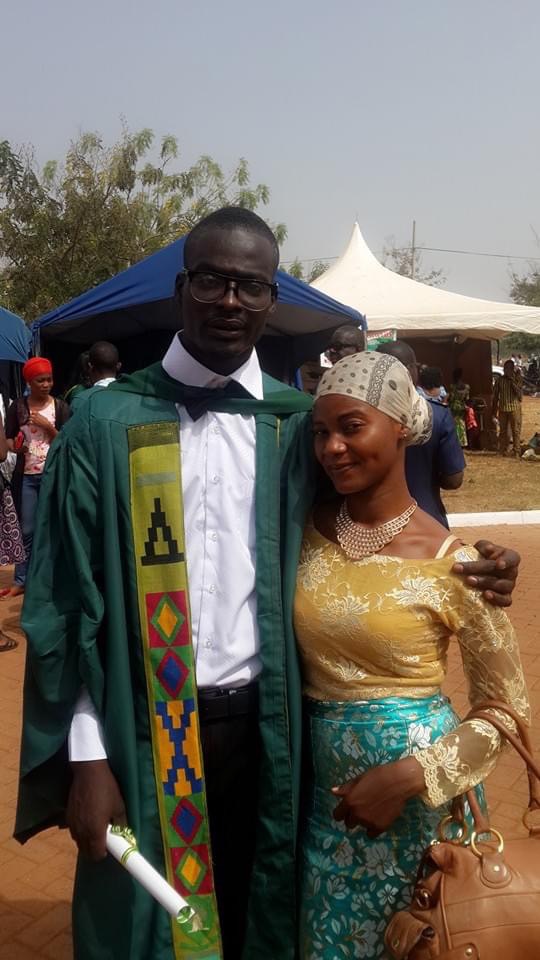

After three long days, there was finally relief. Most of his kidnappers left, leaving only one person in charge to look after Sana. But this was Sana’s lucky break. The one in charge took pity on him and let him go. Although badly injured, Sana was able to get away. But despite no longer being held captive, he was still not completely free from the terrorists.
2. Important Work in the Field
“You are devoted to do it for your own people and for the country as well.”
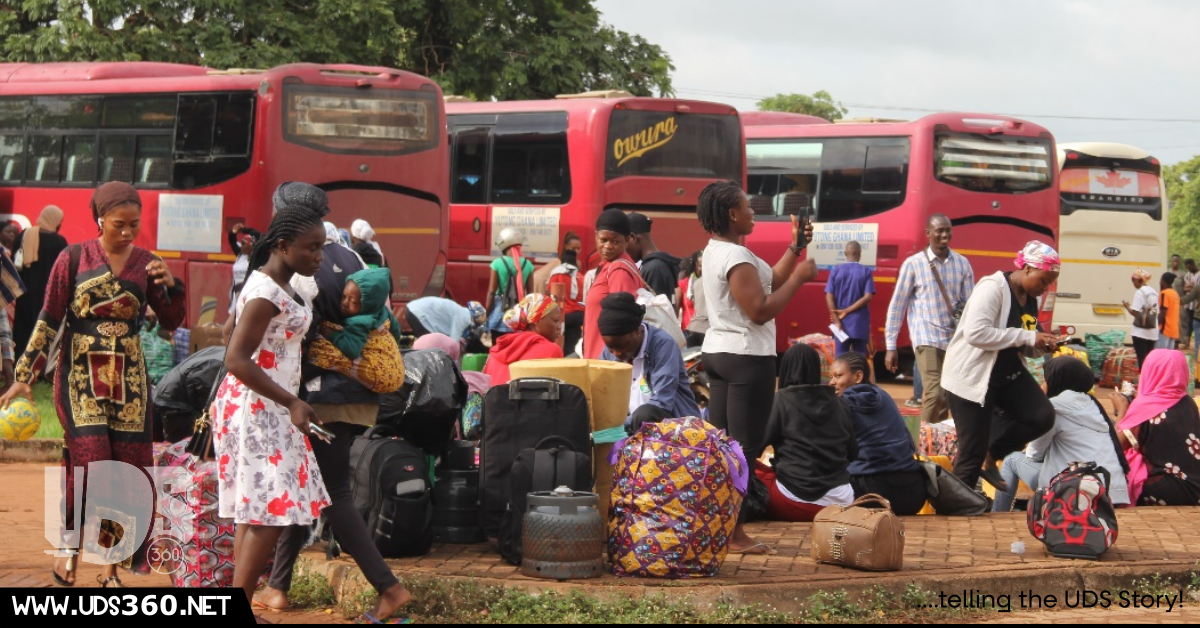
Sana originally took part in the TTFPP as a requisite for his major in Developmental Studies during his time at the University of Ghana. Students are required to spend a total of eight weeks in their designated rural communities over two years. The first year, they spend in the community, so they better understand their needs. Sana explains, “We talk to people and try to find, like, try to know the problems they’re facing and try to know like what they want.” In the second year, they begin working on the projects they proposed, staying for two months in the communities. The work was not glamorous; Sana mentioned that sometimes they would have to take boats to get to the most remote areas for their outreach. Although he described his time as “like in military,” while he spoke to us, he smiled as if he was fond of those times and held good memories. Despite the effect his involvement in TTFPP had on his personal life and well-being, he did not seem to hold any resentment or regret for the time he spent advocating.
“It was so hard, but we were able to do something.”
While in this program, Sana talked about how he was one of the communicators, bridging the gap between community and university, “I was a person who…talked to people and also tried to like enlightened them about like the effects of what they were doing.” However, this put him in danger, as not everyone he talked to would be receptive to the message he was trying to spread. “When you try to talk to them, they get angry. They say, ‘Who are you to come and tell us this and this because you have gone to school.’ They would chase you out and try to even beat you.” The work was important to Sana, but it also put him at the forefront of a battle of ideologies between him and the terrorists.

One of the main issues Sana liked to bring up during our interviews with him was the issue of women’s rights. He first brought it up, unprompted during the initial interview “So sometimes we talk about crime, social issues in the community.. gender equality, we fight about those things. So we were targeted by the government and also these terrorist groups that call themselves jihadists.” He brought this up when asked about his reasons for leaving Ghana for Japan: “So they always say like it’s just a cultural practice, so we cannot abolish it. So we also insisted they should abolish those kinds of practices.” One of these outmoded, or antiquated, cultural practices Sana highlighted was Female Genital Mutilation (FGM), a traditional practice that removes female genitalia for non-medical reasons. A hard subject for one to talk about, much less with complete strangers, yet, Sana mentioned it to us. FGM is practiced in many countries, including Ghana. It was criminalized by law in 1994. The law was then amended for clarification in 2007, but despite this, FGM is still practiced in the upper regions of Ghana. There is disagreement internally between leaders in the Muslim community on whether FGM is allowed by the Hadith, which is a separate doctrine from the Quran.
3. Terror One Cannot Escape From
“This kind of terrorist group…they have their way of life that they live, and they want to force it for the people to live like them.”
The Group for the Support of Islam and Muslims is a militant jihadist group in the Maghreb and West Africa (Ghana and Burkina Faso) and is also referred to as GSIM in English or JNIM in French. A conglomerate of Al Qaeda affiliates and offshoot groups formed a larger one to exhibit more power in the Sahel religion of Africa, which includes parts of Senegal, Mauritania, Mali, Algeria, Sudan, and Burkina Faso along with many other countries in the African continent. Over the years, their power reached past these smaller spheres of influence in the greater area of Burkina Faso and reaching into Ghana. Responsible for many attacks and deaths in the area.

The group frequently gets into gun fights with the Ghanaian army; in October 2022, they killed 13 soldiers from the Ghanaian army, and earlier that April, they claimed to have captured a member of Russia’s Wagner group in Mali. The Wagner group serves as a private army to that of the Russian president, Vladimir Putin. In 2018, the US national intelligence agency added GSIM to its list of Foreign Terrorist Organizations. In November of 2022, France ended their Barkhane Operation, which sought to establish stability and lessen Jihadist influence in the Sahel of Africa (which includes Burkina Faso) after a decade due to an increase of terrorist attacks and instability in the region despite their military presence. GSIM believes in an ideology of the Muslim faith called Salafi-Jihadism, which is a belief that the Islamic faith should return to the original days of the prophet Mohammed. GSIM as a group has been known to use community disagreements for their political gain.
“It was so difficult for us to live in the community again.”
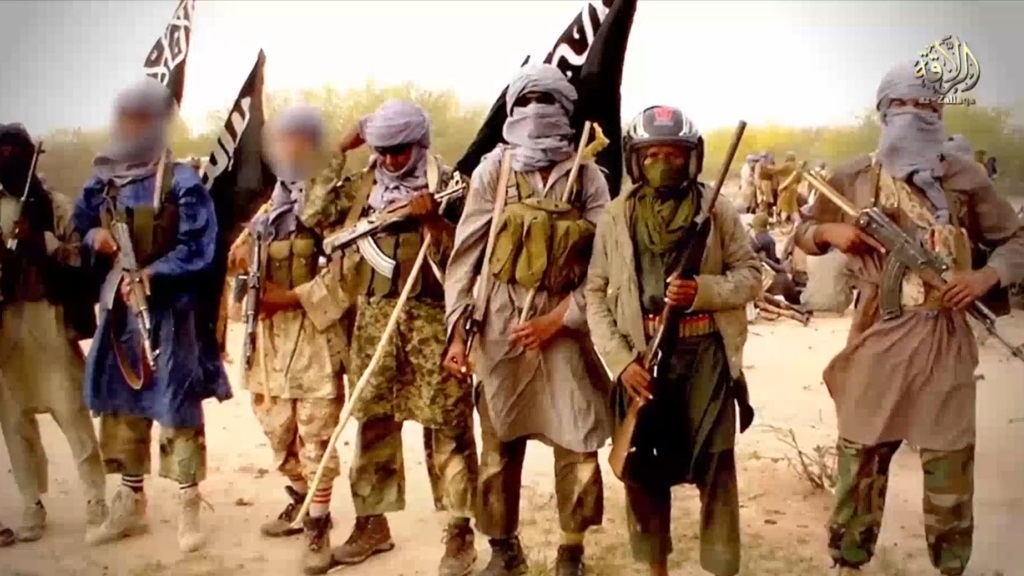

“Sometimes they try to attack us and trying to tell us if they see us like going around the villages, they would kill us,” Sana explains how his university group was threatened by the terrorist group GSIM. He also cited what they would say to them, “we should rather stop what we are doing. But yet we refuse, and they start they try to target our group.” Sana was not the only one whom this group targeted; an activist from the same group, a friend, was murdered by them. When we asked him if anyone had been targeted directly by the group, he confirmed, saying “So one, one of our group members, he was even killed.” He explained to us that his group member had been actively attempting to educate those in the rural area about an influenza vaccination as the infection was spreading in the community, while doing so, he was spotted by the terrorist group. “So he went to talk to them, and he was coming back alone, and they shot him. So he died.” But despite their pleas for help, even the police, those sworn to protect their community, found themselves targets of violence and death. “So they were like, they exchange shots with the police when we reported, and they killed like three policemen, and also six of them also died.”
Things had not always been this way. Sana told us what his community was like before the conflict with the terrorists, in particular, the comradery between Christians and Muslims. Although history likes to pit these two cultures against one another, Sana said that was not how it was growing up for him, “So we were living peaceful and like living together. Eating together. But we understand like everybody worship God and our mode of worship is just different. So we understand that way.” Sana even told us that he went to church with his Christian friends and was quick to admit that his first girlfriend was Christian. “First girlfriend was Christian. Yeah. And I used to follow her to the Catholic church.” Not everyone felt this way; one of Sana’s uncles was stricter than Sana’s father, but when Sana speaks of this conflict, he clearly disagrees with his uncle’s views. He described his uncle as “too strict” and spoke of his father’s disagreements with his brother, saying “he’s strict and he should be like, try to be like rational.” Sana continues, “So he shouldn’t just be like that. And if they are not Muslim doesn’t mean that they don’t practice their religion. So we all believe in God, so we worship the same God. So it’s only God that we judge. That’s why he always tell him.”
4. Collateral Damage
“So they said like, they have to [get] revenge, they have to make sure that they get us.”
Sana soon found that when one crosses paths with GSIM, their extended family also gets pulled into the fray. Once the terrorist group realized he was at the center, the one who had given the information to the police, Sana became even more of a target: “So I told the police everything and they got to realize that I was the one who gave the information about where they are and where they are living. So that was the main reason why.” His family began to get threatened as they looked for Sana and his whereabouts: “Sometimes they just try to attack them with gun, like asking them about my where I am about. So trying to ask them like…to produce me out.”
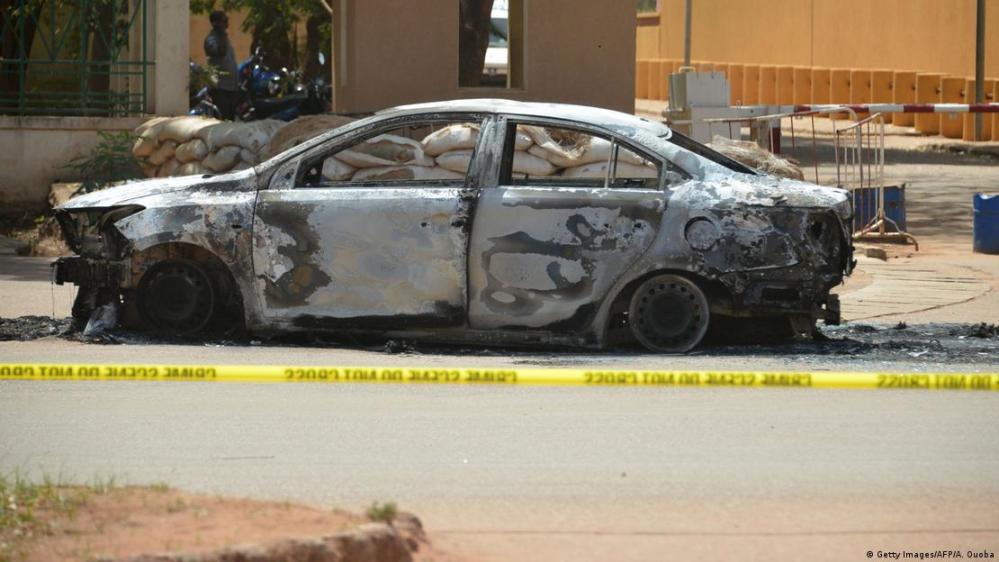
His uncle, unfortunately, became caught in the crossfire as someone whom Sana spent time with and frequently did business with. His uncle was targeted and shot, but luckily he survived. This attempt on his uncle’s life would not end there, as Sana would later find out after having fled to Japan, his uncle had been attacked for a second time. This time the terrorists had been successful. “It was so terrible how they just kill him,” he said about the murder of his uncle, his voice although still measured, there is an underlining sadness. We could all tell Sana cared deeply for his uncle and the wounds of his death still ran deep.
5. In the Dead of Night
“Because when they killed our uncle, he [our father] was so much in pain.”
Sana realized one day just how much of a target he had become. While working for the government of Burkina Faso after his kidnapping, the taxi his group was in was attacked and terrorists stopped the taxis and began pulling people out. “So I was in the first taxi…the second one, they attack the second one…but they didn’t kill anybody, but they got them injured.” Although he said he was unsure if he was the intended target, the run-in made him realize he was still a target and that his future in his homeland was uncertain, that maybe it was best to leave for a safer country. His other brothers had already left, one going to Germany on a scholarship and staying there. His younger brother was not the only one, explaining “All of us left because we were just basically targeted cause of me. So he (his father) made sure that we, all of us would have to go. So my younger siblings, my other brothers, so we all left.” This was not a decision that Sana took lightly, and the stress of leaving his sick parents behind took an emotional toll on him. He recalls, “So I was not so happy to leave them behind. So I’ve, I cried like almost three days before…I agreed to move and most of my siblings already left, so I was like the only one at home. So I told them that, okay…I will move.” His father insisted, saying he would do whatever it took to get his sons to safety even if it meant selling his own property. He had agreed to flee for his safety, but now he had to choose a location, and he chose Japan. “So I said, I like Japan;” Sana explained to us why he decided on Japan as his destination.
His aunt, a businesswoman, had been given an invitation to Japan for a business conference. However, she found herself unable to go, so she extended the offer to Sana. “So they just decided to use her like position to change to my, to my name, for me to get the chance to live. So I have to come with a business visa.” Sana explained that they had been applying for him to enter Japan as a refugee, but the process was long, and this was an opportunity. “So they told me that I shouldn’t worry. So my auntie said they will take care of both of my parents, so I shouldn’t worry. I should just go for me to be safe.” His aunt assured him of the safety of his parents, but Sana, when speaking, emphasized that the decision to leave was a difficult one for him: “So then I left, but it’s also difficult.” He described the lengths the terrorists go through when they set their sights on the destruction of an individual: “Normally when they come, they destroy your home. They can burn it. So yeah, when I’m around they can do that. They know if I’m there, so they can just come, they start looting your home and like taking your properties..and sometimes to they can stand far away and start shooting.” Sana continues, the terrorists are uncaring of the collateral damage done to those around them, and at times “bullet can hit one of them like accidentally.”
“We were afraid anything can happen. They can attack us on the way.”
When we discussed the logistics of his move from Burkina Faso to Japan, we asked him if had anyone that he could trust. Sana told us no, saying “It was like, just secretly and I left it the night.” He continued, “So they picked me with the car and we just got there. So my uncle’s, my uncle son, he picked me to the airport.” As Sana spoke, his normally calm and pragmatic demeanor began to falter; it felt like he was holding back his emotions, holding back tears as he spoke of having to leave his loved ones behind. Afraid of any attacks, they left at midnight, and Sana went from Burkina Faso to Morocco, where he finally felt a sense of relief. He recalls the feeling, “I’m now far away, so even if they want to target me, it has to take long time for them to even know that I’m here.” After spending the day in Morocco, he crossed into Turkey, where he then flew to Japan. Once in Japan, a new chapter of Sana’s life unfolded.
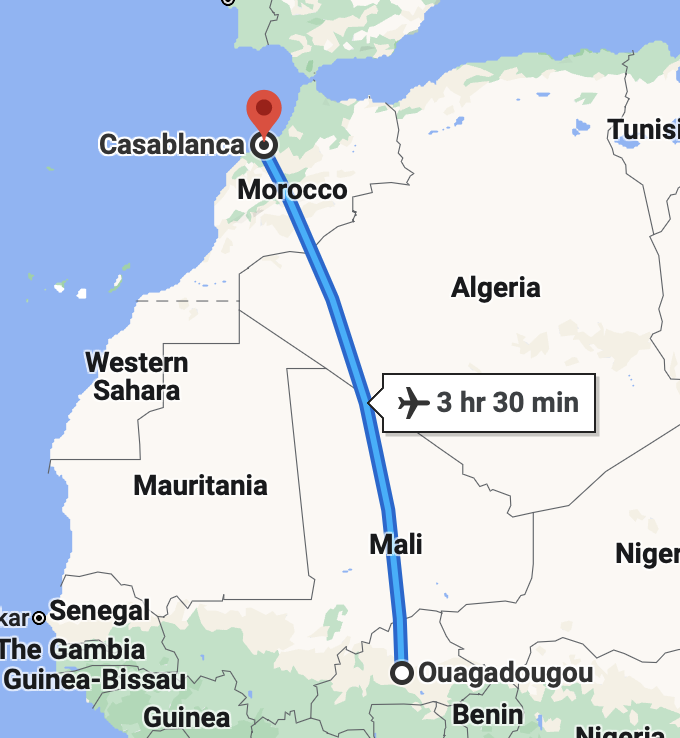
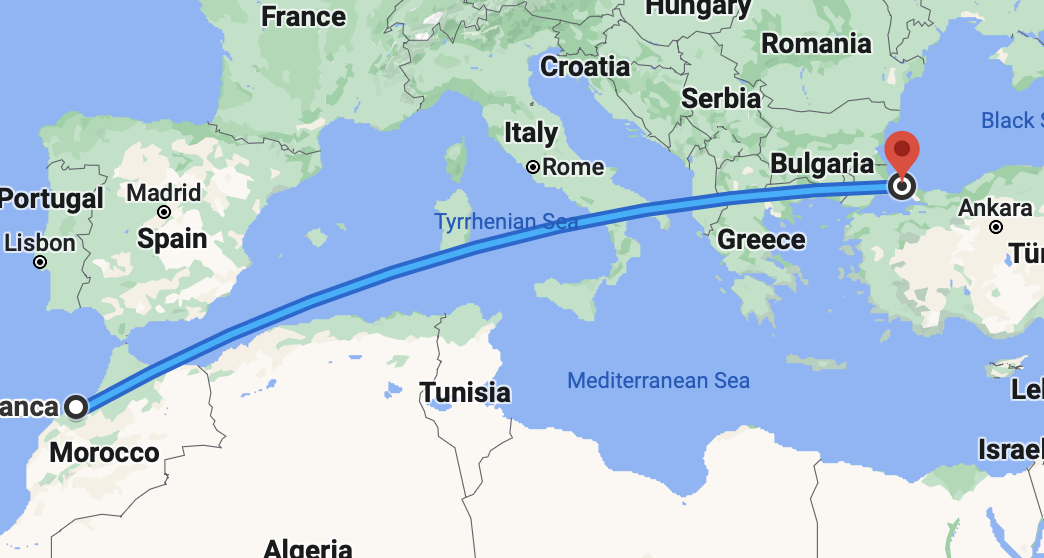
and then to Turkey (Google Maps)
