Detention Center

JAPANESE VERSION 日本語版はこちら

For Sunday, the hardest time inside the detention center was his first day when he missed his family dearly and was very worried about them. But other than that, he says other times were nothing for him because he was free to talk, meaning that he will not be persecuted for what he says with conviction.

Sunday was a brave leader figure who would influence others and speak out to make changes inside the detention center. His leadership ability and his ability to communicate and influence others are not common things a person will possess, especially in a situation inside the detention center where people would fear to speak against the immigration officers. Without knowing when they can be released, many detainees get stressed about their uncertain future. From fearing their application for release to be canceled to being deported which many detainees cannot afford to happen, the majority of the detainees do not speak out to change their situation.

Sunday as a leading figure who would talk

Before his detention, when Sunday’s application for refugee recognition got rejected he chose one of the few options left for many asylum seekers in Japan which was to file a suit against the rejection. One reason for going to the court is aimed at buying time too, that is to increase the chance of receiving refugee status. Yet gaining refugee status through this tactic of buying time is still an extremely rare case under the unsupportive and impractical Japanese immigration policy. Sunday remembers what he was told by the jury at the court when he asked the reasons for his denial of the refugee status application. The explanations he got were always that the court would accept 80% of his claim, but would have to deny 20%. The conclusion rests on the fact that “everything is groundless”. No further explanation. Instead of the refugee status, Sunday was given the Karihoumen status needed an effort of 3 interviews with the immigration and was required to show up at the immigration center regularly. The status additionally assigns him a particular housing to live in, bans him to work, and limits his activities which made him feel he was strictly supervised. It is not a visa, that is, a status given temporarily to a foreigner who could not obtain a visa in Japan during the times before and/or after the detention.

1. The Day He Was Detained

On December 14th, 2016, Sunday arrived at an immigration center in Shinagawa, Tokyo at 6:30 am. He was with his wife and his two children, hoping to renew his Karihoumen status on that day. Just around a month ago, his second child was born.

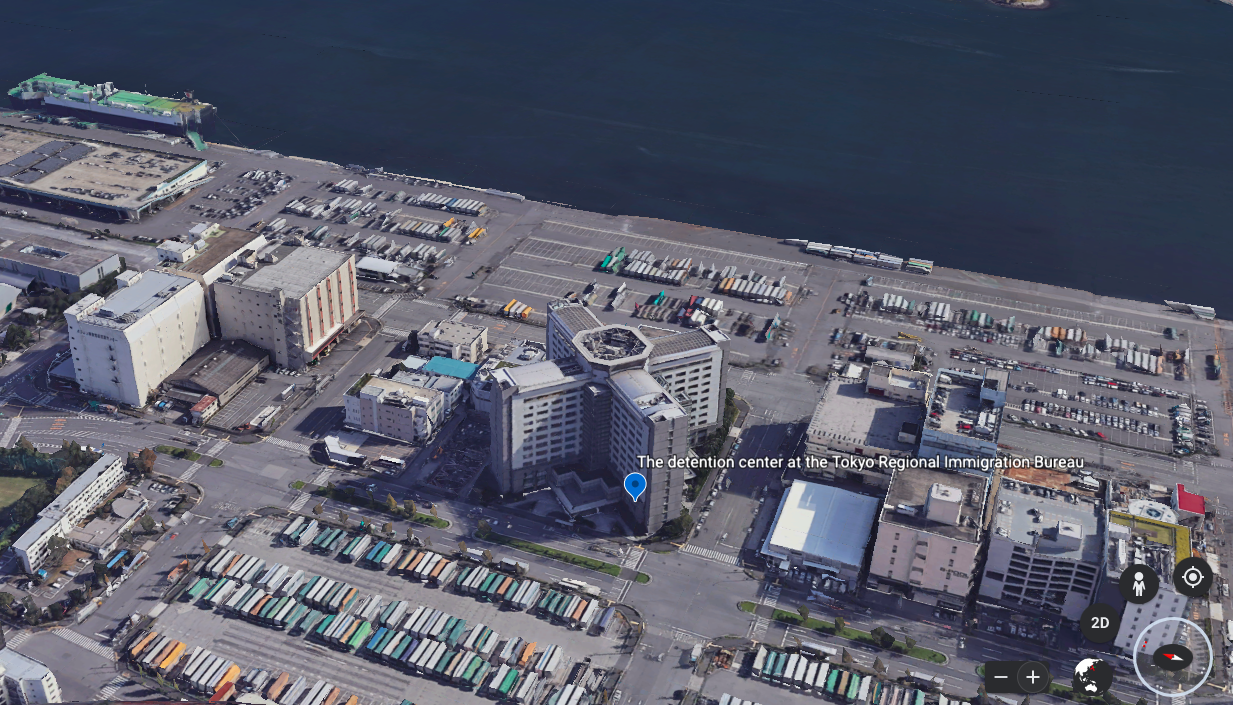
The Tokyo Regional Immigration Bureau (a cross-shaped building in the center) from Google Earth; It is commonly called the immigration center in Shinagawa (Google)
The Tokyo Regional Immigration Bureau taken from a low angle near the entrance (AP Photo/Shizuo Kambayashi)

That day when he arrived at Shinagawa, he already had a feeling that he would not be able to renew his status. It is because he had lost his third court case to get refugee status five days before on December 9th. This third loss meant his possibility of being deported or if not, being detained in the detention center became higher than before. However, because of his newborn child, he hoped for the immigration officers’ sympathy – “I was aware what is going to happen. Except just was a small chance because I had the baby, if they were like kind people, they wouldn’t have done that.”

Unfortunately, his status was not renewed and he was asked to participate in an interview. This time the interview was different than usual. He was asked to do the interview alone, without his children which the immigration used to allow him before. Since the immigration officers were only giving vague responses, Sunday insisted on them directly telling him the purpose of the interview. 

Being asked for an interview at the immigration center

Talk to me straight that today you are going to detain me, don’t say this this this… because I know everything.

“The order from the boss today,” the officers told him in the end. Meaning that his Karihoumen status was not extended, he had to be detained in the detention center that is located in the upper level of the immigration center in Shinagawa. He knew he had to accept the situation because it is not the officers he is talking to but the boss of the Immigration Bureau that was giving the order. One officer he used to joke with walked up to him and encouraged him to “be strong.” Sunday always creates a wide human network with his compelling quality as an influential person, which also helped him significantly to gather information on the Japanese immigration policy. In Japan, there are people like Sunday who struggles to seek asylum to get refugee status because no other person than the boss can only make decisions.

At around 7:30 pm, it was time to be separated from his family. His wife was afraid and refused her husband to be taken away. But their children were too young to understand the situation. Since his wife tried to leave their children behind with Sunday to prevent his detention, many officers came to send her and the children out of the immigration center. “Many people come in, so we try to call, JAR, UNHCR … everything didn’t work,” Sunday recalls the actions he tried to take at his best to let the officers stop monitoring his wife and fighting with her. Nothing more could have been done. “I told her to cool down and accept, and to be strong,” he said. He explained to encourage his crying wife that the detention center is different from a prison, where he would soon try to fight and get out.

2. Inside The Detention Center
At The Tokyo Regional Immigration Bureau

Sunday was an influential person even inside the detention center. He was a source of information and a leader. Inside the building of the Tokyo Regional Immigration Bureau in Shinagawa, regular immigration procedures are underway on the 1st floor. However, there are a number of people locked up in the same building, but on the upper floors which is not open to the public. This is the place where people are taken to be detained. Official information about the detention center exists, although the details are clearly limited. These enclosed upper floors are divided into several blocks where interactions are not possible. Many people live together in separate small rooms and need to share the facility with only basic things for living within each block.

Inside view of a room at the East Japan Immigration Center (Reuters)

Usually, they share a single room with 7-10 people from different countries having various cultural or historical backgrounds. There is a playground that Sunday describes as an “enclosed type of playground” where he sometimes used to “warm up and do small exercises” to keep himself healthy. “Sitting or sleeping” for a long time inside the facility is “sometimes dangerous” for many detainees packed inside the small space. Staying in a limited space with a lot of people for a long period results not only in causing physical problems but also in putting psychological burdens on them. The stress burden was at the level where according to Sunday even the immigration officers whose job it is to inspect the detainees were “also detainees” and “they [we]re stressful much” to the point Sunday “used to hear them shouting too much,” because “they [we]re always inside there, even if they move outside”. He views detention as another form of torture that will drive people to a corner by cracking up peoples’ bodies and minds eventually to deportation.

Without any privacy, people can get very stressed and some fights can happen over very little things. “We need[ed] to become family,” mentions Sunday, despite the situation he was in. “I used to talk to them to accompany, because some people they come in and they fear,” he said by pointing out the necessity and his ability to encourage those who cannot handle themselves with the stress from fearing deportation. Thus he used to inform and encourage others to write an application form for the visa or status to get out of the detention center because many of the people inside either feared or did not know what to do other than being detained. He knew that at least what the detainees can do or are allowed to do while kept inside was to fill out the form for a visa or a status, although the acceptance rate was low. Some detainees were encouraged by Sunday and more people started to ask the immigration officers for the application form. Having been a leading figure back in Uganda, Sunday showed good leadership among the other detainees around him. The immigration officers did not like Sunday telling others to apply for Karihoumen status and warned him that “he is not the master of this place,” perhaps because the officers did not want to have additional work or activities to deal with. Then Sunday would reply, “What am I supposed to do?”,  because talking about whatever he sees to make changes is what makes Sunday who he is. By informing others using his knowledge of the immigration system and procedure in Japan, Sunday positioned himself as an influential leader who would make changes to many people captured in the systematized unjust structure of the Japanese immigration policy.

“This should not be like a prison, it’s just a detention.”

Sunday’s perception of the detention center lies in his belief that “this [should] not [be] like a prison, it’s just a detention.” This principle had always been a key that moved him forward and made him think the immigration system’s orders inside the detention center were restricting him against his value to express and do what he believes is right. According to his experience of being arrested and tortured in Uganda just for expressing his political will, Sunday thinks that the detention center that stops him from what he does and what he believes is right could be as same as a prison because both of them “stop you from what you are doing, and they keep you there.” Thus whenever he tried to acquire his value to inform others about the unjust immigration system, he would confront the immigration officers that “one thing you can do, if you deport me, that’s a different story, which you cannot do” until “actually [the officers] fear for [him] to fight even.” That is when Sunday feels himself being treated with dignity as a person because he can be a leader who would make changes and stand above others including the immigration officers to mobilize the surrounding situations.

Sunday wanted a change. By this time, he had not only been told to stop helping others by providing useful information but also been restricted or ordered what he could do, know, and eat. He needed a change for what he was limited to having access to, and Sunday knew well that he had to. However, knowing that the Japanese immigration system works only through the orders of the boss, he made the rational decision to directly contact the boss.

Sunday had several points he wanted to make clear and ask the boss. 

Here are some examples:

  1. Interminable Detention
  2. Restricted Food and Poor Medical Care
  3. Poor Sympathy
  4. Payment to Get Out
  5. Limited Freedom of Movement Outside the Detention Center

2.1. Interminable Detention

“How long do you want to detain me or punish me in this situation?”

Sunday felt it was not fair that the detained people are not told when they could be released when he argues that even the prisoners are told in advance of their term of imprisonment. Interminable detention is a punishment as it is mostly long-term detention and it holds back both the detained people and their family members to plan their future which increases the level of stress and anxiety. Fundamentally, when immigration understands the fact that many detained asylum seekers like Sunday are never going to get deported from Japan, prolonging the detention period even makes the act of detaining these asylum seekers to be pointless. In addition, since most asylum seekers end up getting the Karihoumen status instead of the refugee status, the series of restrictions they face are more or less the additional unreasonable punishment, which will also be discussed in point 5. below (5. Limited Freedom of Movement Outside the Detention Center). Thus for Sunday, it is hardly understandable why immigration continues to make pointless extra detention for him.

Recently, a news article reported that a new proposal was revealed at the government panel to discuss the issue of long-term detention in response to the increasing incidence of suicide attempts, self-harm, and growing calls from experts, supporters, and detainees like Sunday. However, the panel discussion seemed to shift to “rethink” to strengthen the penalty, only to kick out foreign residents in Japan without sufficient lawful status, such as the asylum seekers on Karihoumen waiting for refugee recognitions because of the unclear and unjust current immigration regime. At this point, although the need to find some alternatives to long-term detention is addressed, there is not much improvement done to find a better “balance between supervision and support,” which is as harsh as punishment for many detainees inside not knowing how long the situation will last.

2.2. Restricted Food and Poor Medical Care
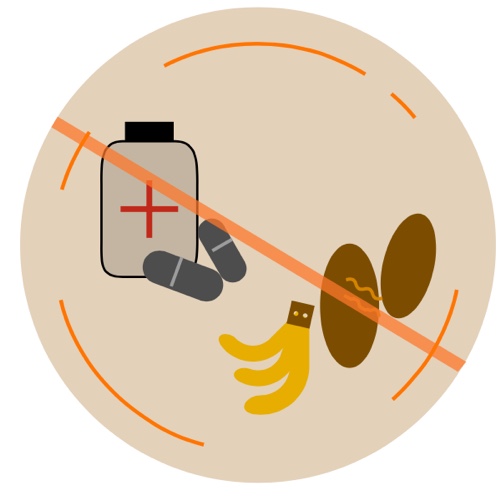
”Why do immigration stop us, stop us from eating banana? It is even we bought, we bought it and it’s expensive with our money.”

The food provided by the Japanese immigrants was of poor quality which made Sunday feel that “I can’t eat, why I have to eat this” because the food such as “two eggs, two meat, and some bread” were “cold,” and those bland food were low in quality as much as they “made [him] not for a human being,”. Some detainees like Sunday have some money “used to buy some banana[s]” with one’s own money, however, those who cannot afford to buy can starve or become malnourished. In fact, there have been several cases reported in which the detainees claim that an example picture of the poor quality food provided by the Ministry of Justice is significantly different from the food they actually eat.

“They are not even nurse[s] or doctors, they are just maybe officers who didn’t know what to do, they just give you drugs, you take the drugs and that’s all, they don’t care.”
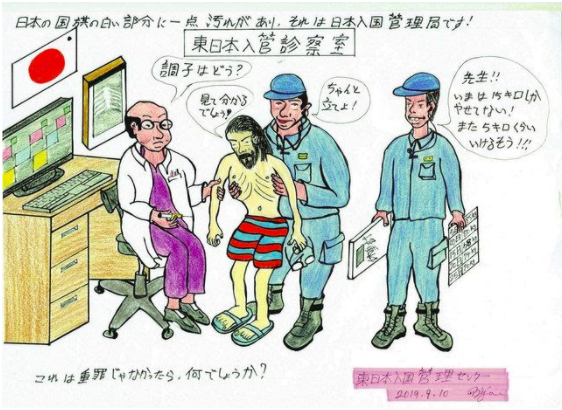
An illustration of the poor medical care system inside the detention center, retrieved from the association supporting detainees at the Ushiku detention center (Tokyo Shimbun)

When Sunday was sick, he was always given the same medicine for a few weeks even if he had different symptoms. He mentions that if one person’s “sickness is serious,” they “just take him to some hospital, and maybe not a good hospital,” which is possibly worse than the clinic inside the detention center because the detainees have to be tied to handcuffs. This is not only the case for Sunday, and it is reported by many other detainees that painkillers are the only drug given to them after waiting for an appointment to see the doctor which takes several weeks. It is easy to imagine that not being able to access medical care when being sick and weakened is an action that violates basic human rights. This poor medical care reflects the systematic feature of the uncaring and indifferent Japanese immigration system.

2.3. Poor Sympathy

“I will stay with my disease, because if you put one of this(handcuff), maybe I get my memory(of persecution) back.”

Sunday thought that the immigration rules neglect detainees’ will, and never learn from them. Whenever he was about to be taken to a hospital outside the detention center, he suffered from flashbacks of persecution. Other than that, countless interviews he has taken part in for years where Sunday has to answer the many questions that provoke his memories of his traumatic past. “Then what evidence do you want me to produce, the one after my death occurred?”, in which he questions the poor understanding of how emotionally hard it will be for him and that he presented all he had of himself as proofs other than the death, the last thing he could possibly offer.

The lack of sympathy is also from the arbitrary decisions made by the Japanese immigration process that hugely depends on the unpredictable orders by the boss of the Immigration Bureau. Not only Sunday but also according to Ushiku no Kai, most detainees who apply for Karihoumen status experience rejection without any reason. It is an endless cycle that seems to continue as the decision is dependent on the boss that does not directly contact the detainees which makes it impossible to have sympathy for the detainees. Whenever suicide cases and self-harm incidents were reported, Japanese immigration stated that there was “no relation” to the detention system itself, which is a problem that ignores human dignity.

2.4. Payment to Get Out

“[The immigration] asked a payment of 100,000 yen, it’s not bad but in my situation is bad.”

Sunday’s message on payment

Sunday questions why detained people are asked to pay quite a large amount of money, a deposit to go out when the immigration bans them from working. He wanted to ask to reduce the amount as much as possible because, for Sunday and many other detainees, his friends and some NGOs’ financial support were needed and used for the payment. Also, a guarantor who lives in Japan is required for every detained people to get released which is difficult for many people. It is difficult for many detained people because getting a guarantor is extremely difficult even for Japanese people. Guarantors have a huge responsibility for the payment, which is also about building trusting relationships. Still, many detainees would find it hard to find a person whom one can ask for that much responsibility. Considering the fact that many asylum seekers who aim for refugee recognition inside the detention center are captured and forced to be detained by Japanese immigration, the orders that ask for these payments are incomprehensible.

2.5. Limited Freedom of Movement Outside the Detention Center
Of course, people inside fill out a form to apply for the Karihoumen status to get released from the detention center as soon as possible. Sunday was indeed one of them too. However, here, Sunday is making a larger point on why he believes that being detained and getting out of the detention center yet living on the Karihoumen status is the same in the sense that they both limit a person’s freedom of movement. This is in fact a rational point to address when looking at the unjust structure of the Japanese immigration policy.

“I didn’t know when I am going out, and even if I am out, I am not supposed to do anything, how do I survive?

The limitation of movement on Karihoumen and during detention

The point and the drawing below are an embodiment of how he thinks that living with Karihoumen status but without a visa can be considered as limiting one’s freedom of movement which is equivalent to being inside the detention center.
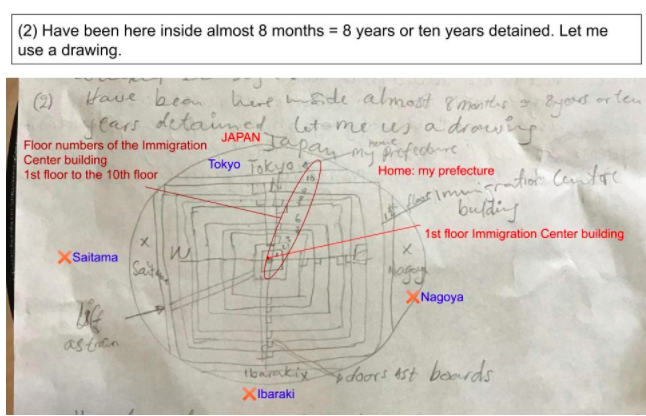
Sunday’s drawing that embodies how the Karihoumen is the same as the detention center (Sunday drew this while he was inside the detention center)

Sunday uses his own drawing to explain his point that the system of Karihoumen status is no different than the detention center. The top view of the image of the detention center from the 1st to the 10th floor surrounded by a circle line represents the function of the Japanese immigration policy. The square lines show the ten-story building of the detention center located inside Japan which is depicted as a circle line. The remaining areas on four sides represent the four cities Sunday is familiar with, which start clockwise from the top, Tokyo, Nagoya, Ibaraki, and Saitama. Since Sunday was not allowed to move to different blocks or out of the detention center when he was inside, same as that, the cross marks show that he has no right to freely visit other prefectures with his Karihoumen status from Tokyo where he resides, without permission. The circle line as Japan encloses everything inside it.“In Japan, if you don’t have a visa, you have to accept immigration rules. Whatever anytime, even if you have Karihoumen, it doesn’t matter. They can cancel anytime. That is a bad thing about Karihoumen [status]” said Sunday. It is true that Sunday thinks that Karihoumen status is still better than being detained. However, the point he is making is that, for him being in Japan with only Karihoumen status that limits his freedom of movement is basically being in the detention center is reasonable. This falls into an endless cycle of a struggle that Sunday is nevertheless basically on detention all the time.

3. Leading The Strikes And Speaking Out

Every day, at the detention center, obento – packed food in Japanese – will be distributed 3 times a day. However, these food are not necessarily suited to everyone with different cultural or religious backgrounds. It was also cold and Sunday did not appreciate it. Officers just bring obento and take it back, if the people did not eat. From Sunday’s perspective, the officers kept bringing the same obento because “they have to bring the food” as their assigned job, and it is not their job to consider trying to make efforts for improvement. Thus some people would purchase additional food to eat on their own but only if they can afford themselves to do so. One day, Sunday was not allowed to eat bananas he bought with his money but he did not know why.

“There is nobody, one month, two months, people that are always there, they don’t release anybody, so I decide to think, what can we do?” Sunday was aware that the Japanese immigration was not willing to release detainees or to deport them at their own expense, which made some detainees whose government do not cover the returning transportation end up staying longer inside. As immigration was bringing in more and more people, and he knew the Ugandan government was not going to pay for him to return, which he couldn’t anyway, he thought of what he could do to change such a situation. Detention centers in Japan should “not [be] like a prison,” Sunday says repeatedly. It is like another form of torture where there will be no other choice either to obey or fight against the uncaring immigration orders such as interminably detaining them, restricting food, not providing sufficient medical care, and turning a deaf ear to the detainees’ issues. Sunday, as a brave man, decided to speak out against the orders because he did not like to simply be an obedient person but to lead others. 

One way to do so was a hunger strike, which is a type of protest that appeals to the morality of human beings by refusing to eat anything for a certain period and aims to achieve specific goals. Recently in Japan, the death of a Nigerian man at the Ushiku Detention Center in 2019 June after a hunger strike might be fresh in our minds. (Nigerian dies after hunger strike in Japan detention center in June 2019)

The moment Sunday decided to make a strike

“[The immigration officers] stop you from eating banana, you are going to die here, inside, so I tried to convince them to, maybe to make a strike.

The ultimate goal that Sunday and some of the people who followed his idea of conducting the hunger strike was to meet the boss of the Immigration Bureau. They wanted to ask why they were not allowed to organize themselves and why they were restricted so much. However, the hunger strike did not go according to plan. Not all the detainees could refrain from eating to meet the boss for an unreasonable order. “We got weak” and “they ha[d] to eat. But me, they always bring my food but I d[idn’t] eat,” said Sunday as he never wavered from the plan to conduct the strike. Meanwhile, the immigration officers kept on suspecting Sunday of planning to make a strike which bothered him, yet this never made him think of giving up.

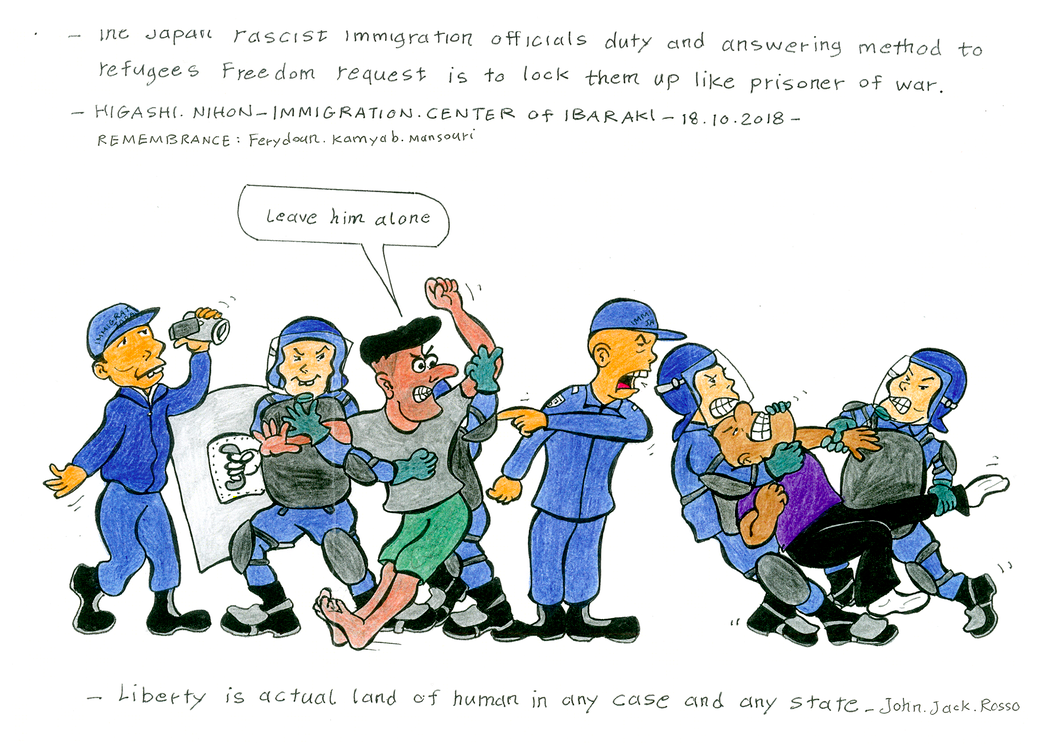
Therefore, Sunday came up with a new idea to show their resistance. “We change the plan, we said we want to talk to the boss, so today we are not going inside until the boss comes here and talks to us,” he said. In order to meet and let their voice be heard by the boss, Sunday never gave up. According to the immigration’s daily time schedule, people inside the detention center are always called to go inside each of their assigned rooms at 5:00 pm. However when they were told to return to their rooms at 5:00 pm that day, Sunday and some other detainees on this resistance kept standing outside the rooms. After two or more hours have passed, a lot of officers came with a kind of protective gear and began to use force like grabbing and pulling to let the people in the detention center go back into their rooms. They brought big speakers, shouted, and kept saying “There is no boss, it’s over.” While several detainees who are there for years were shouting because they were overly stressed, Sunday remained cool-tempered. But “it was a war, they come by force,” he remarked. He was surprised to see many immigration officers turning aggressive. “In my impression, they are animals, not human because the way they push us, I can’t believe it,” said Sunday in amazement. He felt he saw the other darker side of the officers’ hearts. At last, the detainees ended up in their rooms with force.

Recalling the day he resisted going back into the rooms
An illustration of aggressive officers trying to use force to suppress the strike which matches Sunday’s narration on the strike to some extent (Asia-Pacific Journal: Japan Focus)

As a result, the officers told them to pick a form to make an application to meet the boss. Most people did not have enough courage to do so because they feared that their actions may bring disadvantages to their situation. Unlike others, Sunday filled out the form, but things did not go as he expected. Being told that the immigration officers will let him meet the boss by filling out the form, Sunday was taken to the hospital instead. He not only couldn’t meet the boss but also was deceived by Japanese Immigration.

“I was surprised, the day they come and they are going to meet the boss, and they take me to the hospital.”

Deceived and taken to the hospital instead

The Japanese immigration officers deceiving him not to arrange a meeting with the boss depicts how the detainees and notably Sunday were treated with little regard and lack of seriousness. Sunday felt that the doctors at the hospital did not “know anything” about the point of his problem. He had to explain to the doctors that the form was directed at the boss and not to them. Such an incomprehensible conversation had made him realize that meeting the boss was never going to happen. Yet even after this event, his ability to talk and to step forward for actions did not fade. No matter the consequences, Sunday was able to clearly state his values and the points he made as he stated that “my style is if somebody makes [an argument or states] something different, it doesn’t [matter to] me,” and “what matter is about me,” because he believed that being ignorant of the unjust Japanese immigration orders and the uncaring Japanese immigration officers will just make a person ignorant too. It was essential for him to be rational and reasonable during the difficult times inside the detention center.

4. Coming Out Of The Detention Center

1. The Day He Got Released

Finally, after eight months, it was the day for Sunday to get out of the detention center. In fact, Sunday could have gotten out earlier as he was informed that his application for the Karihoumen status was confirmed after seven months inside the detention center. However, as also mentioned in 4. Payment to Get Out above, his guarantor told him that he was so busy that he did not appear to meet him for some time. Getting out is another difficult thing. The guarantor who is responsible to take care of a person with Karihoumen status after the release was necessary for Sunday to get out. Another month passed, and Sunday found a different person who could come pick him up at the detention center after asking his busy guarantor. Although had been waiting for this day, he had mixed feelings on that day. He was given a Karihoumen status and his time to spend with his family came back. However, it was not a complete release as there were still chances that he would have to return to the detention center anytime as stated in the order system on Karihoumen status that the “immigration control authority temporarily stops the detention and releases a detainee.” After the processes finished, Sunday met his wife and his kids for the first time in eight months.

7th CLIP: How Sunday felt coming out of the detention center

Despite the location, Sunday was and still is a father to his children. This will never change. Now with Karihoumen status, he still has to get permission for all the activities he does and there are many restrictions. 

As of Sunday mentioned, the Karihoumen status is equivalent to being detained inside the detention center in terms of restricting and inspecting a person’s behavior and movement. Sunday’s driving force of informing and mobilizing others to lead for the chance to change was and still is his personality as a born leader. 

“I talk, because I’m free to talk,” Sunday would state it this way because he is a person that continues to influence others by using his impressive ability to voice out any unjust situations against his value.