“They arrested many people and took us underground. So from there I disappeared for around 6 months. I don’t know where, around which place, but there was a lot of torture.”
Sunday was arrested, detained, and tortured because he was a member of the Democratic Party (DP), an opponent party of the ruling Ugandan government. Since DP is considered a threat to the regime, they face several human rights abuses by government security forces. Sunday was particularly targeted because he was a brave, articulate, and influential leader. This is Sunday’s story of how he became a refugee.

Table of Contents
1. Politics in Uganda
In order to understand Sunday’s involvement in political activism and why the DP members are persecuted, we first need to look into Uganda’s history of politics.
1.1. Uganda’s Authoritarian Government
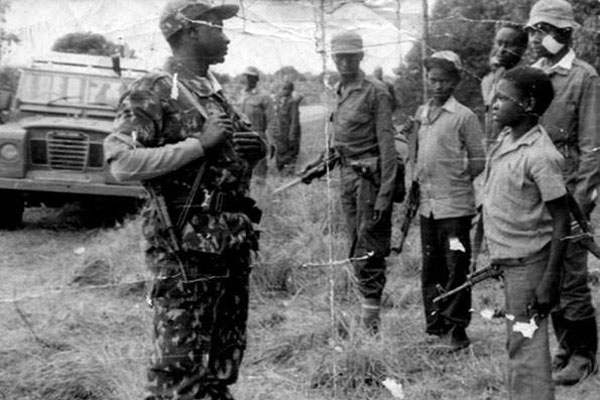
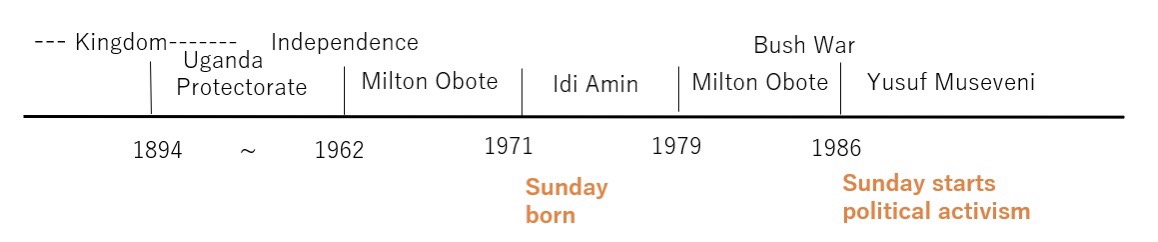
As a child, Sunday witnessed what is today known as the worst period of Ugandan history: an era of massive civilian killings and other human rights abuses including arbitrary arrests, beatings, and torture. This was driven by the military dictatorship of Idi Amin (1971-1979) and violence directed by Milton Obote in the 1980s. After a five-year-long guerrilla war (Bush War), in 1986, Milton Obote with its ruling party was overthrown by Yoweri Museveni from National Resistance Army (NRA). Although the stability of the country has improved since then, violent conflicts and human rights abuses still remain. All three leaders have a common point; they are dictators who have taken over power by the use of military forces. As the military is used as a tool to solve internal conflicts, countless numbers of civilians have been victimized, and democracy has been absent in the country.
Sunday explains this whole chaos began after Uganda became independent from British colonization in 1962. Before independence, Uganda was divided into 5 kingdoms, each ruled by a local king with centuries of powerful tradition. Sunday’s family was from a Royal family clan from the most flourished kingdom, Buganda. As the king’s role was to succeed their family traditions and protect the kingdom during conflicts, the state of affairs was rather peaceful. After independence, a president was chosen to rule the country. Although the first president was the King of Buganda, prime minister Milton Obote started to capture the kings and eventually took power. In 1967, when Uganda became a full unitary republic, the kings were completely abolished. This disrupted peace in the society, and since then the government, dominated by autocratic and militaristic leaders, has been failing to protect its citizens.
“It’s not a government for people, a lot of pushing to people.” “Someone takes power as a president so those who are in power they try to pose too much to those people who don’t have power…They capture all the wealth to themselves now”
1.2. Fighting for Justice
Against the autocratic government, several groups, including the Democratic Party (DP) to which Sunday belonged, have been bravely raising their voices for moral and human rights issues. The DP has been a leading moral voice, raising “truth and justice” as their motto, which is apparent on their emblem.
As Sunday’s father was a member of DP, Sunday felt entitled to be involved. Out of his 59 siblings, Sunday felt closest to his father since he was proud to be chosen as the successor of his father’s name, “Bamweyana.” When Sunday’s father passed away in 1986 due to government forces during the Bush War, Sunday felt his duty to fight for justice and started political activities at the early age of 18.
“Because I feel bad, sometimes I feel bad to see a lot of people in pain.”
“Like eh and I see and whatever government doing, stealing like I see, because some have the history, some I see physically, things started like a lot and I grow up and getting stronger wherever I go I talk, whatever government is doing I talk.”
Sunday was aware of governmental corruption and cared for those victims. While others like his brothers feared to talk against the government, he was not afraid. Needless to say, Sunday was great for talking. He says, “I started moving with the big people everywhere talking too much. I started getting elected.” His role became a recruiter, who invited people to join DP, which was an important job since the group raised money as people joined. Sunday was able to talk in many areas, as he traveled to many places as a marketer in his company. After he finished his job, he would do political activities and be successful in inviting many members.
1.3. Oppression of Political Opponents
While Sunday and other DP members fought for their moral rights, the government’s ruling party eliminated those who were suspected of being disloyal through harassment and arrests. Silencing dissent started in 1986, under the Museveni government which claimed a “no-party system”; independent political parties were legally banned from political activities, including holding public events such as seminars, conferences, and rallies. Not only political parties, but journalists, Human Rights activists, and other groups that are unsupportive of the government have been highly restricted from rights to freedom of expression, association, and assembly. Even under this situation, DP was considered some of the most remarkable voices in the 1990s. (SOURCE: Uganda Silences Political Parties )

2. Arrests, Detention, Torture
On the day of an election in 2001, Sunday was at the voting center in charge of making sure there were no voting irregularities. At the end of the day, when counting the number of votes, Sunday was skeptical that the government agents were trying to manipulate the votes. Sunday refused to cooperate with their suspicious orders, and then bullets were shot in the air. Sunday was fearless, he says, “Everyone ran away, but me, I stayed.” He was not going to let the government take advantage of their unfair procedures. At that moment, Sunday was suddenly arrested for the first time and taken into a car by the government security agencies.
2.1. Safe House
Sunday was driven to an underground facility, known as a safe house, where political opponents who are arbitrarily arrested are detained. Since safe houses are hidden, and no outsiders have access, the location of safe houses and the number of people detained have not been sufficiently investigated. The government even once denied the existence of safe houses, although there are over thousands of claims of testimonies from victims. Sunday explains the time he was arrested and detained.

Sunday was isolated from the outside world, in an extremely dark place where he often heard people crying. As Sunday had his own family at this time, they must have been worried and terrified when suddenly, one day, he did not return home. Sunday mentions in the video, the officers often blindfolded him and drove him to safe houses in many different areas; this was in order to prevent the location to be identified, so if and when detainees get out, they cannot inform others of the place. Sunday further expressed, he lost a sense of place and time.
“I don’t know how I reached there, but I found myself there. I don’t know if I got there what time? or I was staying there for a long time, I don’t know.“
Inside the safe house, Sunday was psychologically and physically tortured. While Sunday was asked questions about his political activities, he was intimidated and beaten. In fact, the purpose of safe houses is to interrogate individuals suspected of “treason and terrorism.” Torture is frequently used as a tool to get information from suspects, and they aim to intimidate them until they are no longer a threat to the regime.
From the many experiences of abuse and torture, even today, Sunday’s scars are visible on his forehead, hand, and foot; he has experienced flashbacks due to trauma. Sunday explains that in the worst cases, some detainees were tortured to death.
2.2. Police and Military Brutality in Uganda
Sunday’s story informs us how extremely violent security agencies are in Uganda. Sunday also describes, “There is a problem, like security agencies. Like some people maybe like they think they want to be big, like acting on behalf of the government. They do whatever they want, they have the powers to do whatever they want.” In fact, the police and army have continued to rank the top agencies accused of human rights abuses in Uganda. Activists claim the reason behind brutality in Uganda includes a lack of officers’ training on human rights values and a lack of impunity by the state. Although Uganda is one of the few African countries with an anti-torture Law, unfortunately, they are not implemented.
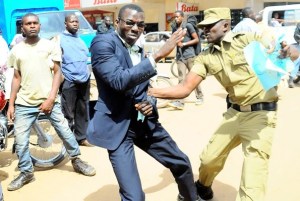
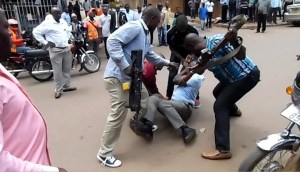
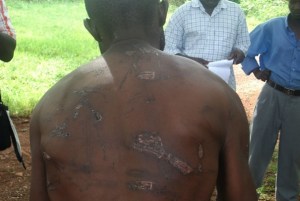
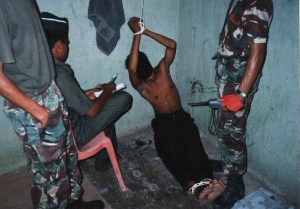
① A member of Uganda Young Democrat (UYD), the youth wing of DP arrested during a demonstration (Daily Monitor)
② A member of UYD being arrested while hit by armed men (Soft Power News)
③ Remaining injuries of a victim of torture (Daily Monitor)
④ A blindfolded man tortured inside the safe house (Eagle)
2.3. Joining the Captures
“You don’t stop like this, you have to support the government too, you have to accept everything.”
Understanding how much power the security agencies held, Sunday realized he could not always be against the government. Sunday was trapped in the safe house, with no chance of getting out. However, this idea helped Sunday find his way out, which was by joining the army. When security agencies were recruiting members, Sunday agreed to go, and in the army luckily one of the army members happened to be his childhood friend who he often saw at playgrounds. Sunday explained his situation and asked, “Maybe you can look for a way out, and eh please you have to help me.” After some military training, when Sunday was assisted by the army leader to go on a car to a different area, instead, Sunday got on to his friend’s car that waited for him. Sunday says, “I was in combat.” He risked his chance of getting caught and successfully escaped.
He came out with a lot of pain, scars, and wounds. “I could not stop coughing, I could not see with my eyes.” The DP Headquarters was surprised to see him back, and he told them everything like the way they are tortured and how many people are detained. Despite the tortures he faced, Sunday continued to be in politics, because he couldn’t ignore the problems he saw and heard. He believed he could manage the arrests and continue his political activism.
3. “I Want to Leave the Country”
Sunday was arrested two more times in 2004. He was beaten, handcuffed, put in water, and paralyzed by electricity shock in the safe houses. At this time, the police had much information on Sunday about where he lived and even had pictures of him and his brothers. He was warned by his friend who helped him escape the safe house the first time, “They (government) are targeting people like you, who talk. I advise you, get out of politics. If you cannot manage, move out of the country.” However, as Sunday continued, the police started to stop him more frequently. Sunday felt ‘something is wrong.’ Sunday was caught whenever there was a demonstration or protest in the city, even those he was not involved in. He says, sometimes, he spent all day at the police office. He was arrested for the fourth time in 2006 with other DP members, and after being released thanks to DP’s intervention, Sunday felt, “Maybe I feel like I want to kill myself, commit suicide.” “I’m about to make a burst.” He felt he couldn’t do anything because he would be stopped and faced with more torture. There was no other way for him to avoid arbitrary arrests and torture. Sunday lost his freedom to fight for justice.
Not only did he feel his own life in danger, he worried about his family’s safety. Although his wife and kids would never be killed because the Ugandan military exclusively targeted adult males who are politically active, Sunday felt he was putting them in danger. He wanted to support his family, but it was not possible if he would continually be arrested, or at worse, kill himself. To protect them all, he needed to live. He believed life matters the most.
“I left everything, I left my children, I left my mother, I left everything, it is better to live.”

.png)