When we hear about refugees in the news, on social media, or in politics, it can feel abstract and factual. Often, we tend to forget that these facts are about real people. This video gallery gives a voice to the experiences they’ve had, which were often very similar.
Themes
These are the recurring themes that can be found in the journeys of people who had to leave their country behind:
Forced to Flee
In international law, the word “refugee” has a precise meaning. The 1951 Convention Relating to the Status of Refugees describes a refugee as someone who is outside their country and has a well-founded fear.
“owing to well-founded fear of being persecuted for reasons of race, religion, nationality, membership of a particular social group or political opinion.”
The 1951 Convention was a vital starting point, but it was written for a different time. As the cases of Nahed and Yasser show, modern displacement is complex, and the reasons people flee today often spill outside the lines of traditional definitions.
This gallery connects those legal words to lived experience. Through short personal testimonies, you will see what “well‑founded fear” can look like in real life: loss, threats, punishment, and targeted violence.
“I had to leave when my colleague died”
Christopher – Cameroon
Christopher founded a union for the Anglophone minority, defying the government. When the pressure turned into tragedy, his fight for justice became a flight for survival.
“They said: ‘Okay, if Gabriel ever returns to Nigeria. He will be a dead man for ignoring our holy Quran.'”
Gabriel – Nigeria
For simply sharing his Christian perspective, Gabriel was targeted by extremists.
“In Tunesia, you know, there is jail for gay people.”
Nahed – Tunisia
In her country of origin, she could face jail for loving who she loves.
“So, from there I was disappeared around 6 months. I don’t know where which place, but with a lot of torture.”
Sunday – Uganda
Because he opposed Museveni, he was tortured.
“Then I told my mum like ‘We’re leaving’. ‘No, It’s like,’ ‘there is no discussion about that.'”
Yasser – Syria
Syrians wanted change, but opposing Assad’s regime forced many, such as Yasser, to flee.
Roots and Realities
Every human story is deeply tethered to their roots. Before their story in Japan began, they had their lives and family in their country of origin. In this section, we travel to the frontlines of personal history. Through their eyes, we witness how corruption, gender restrictions, and political instability infringe upon the sanctuary of childhood. These short fragments explore how the places we come from partially shape who we become.
“My parents were like don’t go out without us. It’s really dangerous”
Ozzy – Liberia
In Japan, elementary school children walk to school safely from a very young age. For Ozzy, simply stepping past the front door meant risking her life.
“People are not really looking for money or something. They are looking for a better quality of life.”
Nahed – Tunisia
When a country falls into anarchy, looking the other way becomes a survival tactic. See how economic despair and corruption are shaping Tunisia’s future.
“Monks in Myanmar don’t talk unless you pay them. Famous ones have expensive cars that cost hundreds of millions of yen.”
Nyo – Myanmar
In Myanmar, the very people meant to guard morality are fueling corruption.
“Happiness was freedom for me when I was a child. When I could go everywhere that I want, freely.”
Ariana – Iran
Ariana’s freedom ended where her childhood did. Watch her story on how gender dictates every boundary, limit, and law for women in Iran.
“They don’t realize that they can empower their own country.”
Christopher – Cameroon
True stability starts from within. Fon Fon Christopher breaks down why local management and empowerment are the ultimate keys to Africa’s future.
Journey to Japan
A passport, a visa, a ticket to somewhere else. Sometimes, the things meant to guarantee a smooth transition lead to the most challenging chapters of our lives. The truth is, many refugees never planned or even wanted to come to Japan. Leaving home is rarely a choice, but a painful necessity. From overwhelming emotion to unexpected airport blockades and sudden twists of fate, explore four powerful, firsthand stories. Step into their shoes and discover what it means to navigate the journey to Japan.
“I was crying like a baby.”
James – Cameroon
Watch how James experienced his first days in Japan.
“What is the problem? My passport? They said, no. My visa? They said no. I said, then What? Why?”
Patrick – Cameroon
Patrick had a genuine visa and a valid passport, but he still could not pass. Find out more about his journey in the video.
“We weren’t really expected to stay, we were expecting to transfer.”
Ozzy – Liberia
Watch how Ozzy and her family got ‘stuck in Japan’ at the airport, while waiting to board their plane.
“The first night in Narita, the person I missed the most was my mother.”
Nyo – Myanmar
Nyo arrived to Japan in 1991, he still remembers his first night…
Asylum Process and Bureaucracy
For asylum seekers in Japan, the journey to safety is often met with a crushing bureaucratic machine. From unpredictable summons to arduous interviews, the system extracts a heavy toll. The process frequently separates families, while life-altering rejections are delivered without clear justification. Even when released from detention, many remain in a suspended state, granted permission to stay but denied the right to work. These stories move beyond statistics to reveal a system that frequently prioritizes procedure over human dignity. We invite you to listen to their voices to understand the true cost of asylum bureaucracy in Japan.
“Because they will tell you that you are here and, as an asylum seeker, when we call you, you have to be here.”
Guillain – Congo
Watch how Guillain’s story reveals the exhausting reality of Japan’s immigration service and get an honest look at the human side of this complex process.
“She cried a lot every time and the were pushing her a lot to say stuff and getting into details.”
Yasser – Syria
Yasser’s story shows the intense nature of the questioning. It offers a glimpse into the pressure placed on applicants.
“Interrogations want to prove that you are a liar or not.”
Ariana – Iran
Find out the difference between interviewing and interrogating. Ariana’s story shows how thin this line can be.
“They don’t give reasons.”
Sunday – Uganda
Watch this short fragment to see how the lack of transparency leaves so many asylum seekers in limbo.
“Karihoumen is not a visa, but it gives you permission to stay.”
Gabriel – Nigeria
Gabriel’s words reveal the harsh truth behind Japan’s Karihoumen status.
Detention
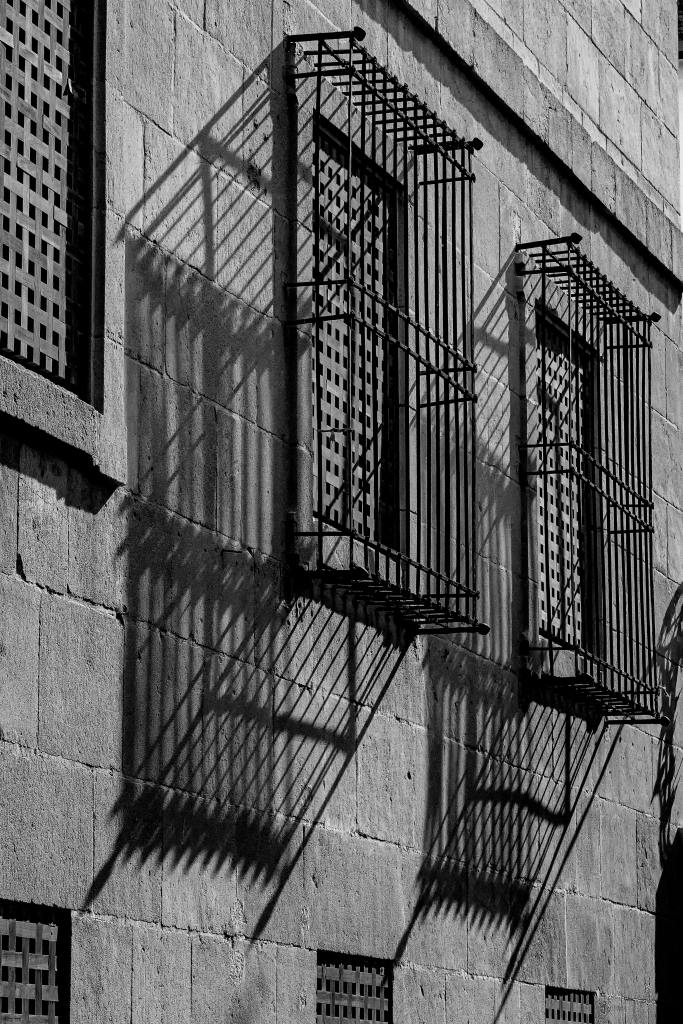
Japan’s 17 immigration detention facilities often subject refugees to indefinite confinement instead of short-term administrative processing. Within these centers, basic needs are frequently met with institutional indifference, and medical requests are often answered only with painkillers.
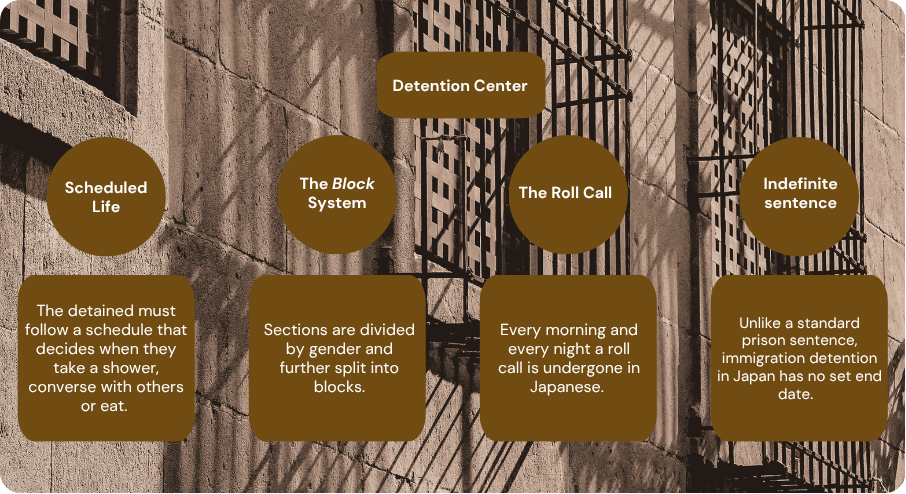
While detainees foster resilience through community and mutual support, they remain in a strictly controlled environment. These facilities mirror prisons through rigid daily schedules, mandatory roll calls, and profound psychological isolation. The following graphic illustrates how the daily routines and physical restrictions in these facilities directly mirror prison conditions.
“This is not an immigration center, this is a prison.”
Patrick – Cameroon
After arriving in the detention center, he realized it looked and felt exactly like a prison.
“what crime did I commit to go on detention?”
Christopher – Cameroon
Christopher briefly describes what it was like to be detained in the Japanese centers. He, too, compares it to actual prisons.
“So, when I go into detention center then I have nothing! So, I couldn’t even buy toiletries, detergent.”
Gabriel – Nigeria
Without the right to work, detainees in Japan struggle to afford basic necessities, a financial strain that Gabriel explains well. He also highlights the inspiring solidarity between detainees and voluntary groups who coordinate to provide essential support for those in need.
“So, I was only fighting for my heart.”
Sana – Burkina Faso
Sana was denied medical exams for his chest pain, receiving only painkillers. He links his struggle to a Sri Lankan woman who died in the center after her own pleas for hospital care were ignored.
“She was always crying and she never wanted to eat.”
Ozzy – Liberia
Ozzy’s story exposes the impact of separating children from their parents. When they are put in a detention center.
Starting anew in Japan
Beginning again can be relieving and wonderful, but it brings its own challenges. Japan has its own culture and specific rules. Coming to Japan means adapting and facing unforeseen difficulties. The fragments of Yasser, Guillain, and Ozzy show you how Japan has become their home. James and Nahed give a view on the challenges it can bring.
“Like in the first six months, I used to cry missing Damascus or my country.”
Yasser – Syria
See for yourself how Yasser feels about his new chance in Japan.
“I think I was lucky because I followed all the steps.”
Guillain – Congo
Guillain found an alternative way to secure his future. He took matters into his own two hands.
” And like, after I came here, I made friends and now I actually have close friends, best friends and it’s all new to me.“
Ozzy – Liberia
Watch this heartwarming change in Ozzy’s personality due to the safety in Japan.
“It had gone off my memory that there’s something called racism.”
James – Cameroon
Starting a new life in a new country also means dealing with new challenges. Find out how James experienced this.
” I really want to work and to start making my money, and to start meeting people.“
Nahed – Tunisia
After a long period of uncertainty, Nahed finally could live instead of survive. Watch how she explains why she can finally build a social life in Japan.
Acts of Hope
Even in the darkest of times, light finds a way to shine through. For many refugees, that light is found in the simple, profound act of helping one another. These testimonies reveal how shared compassion becomes a lifeline, proving that even in the most challenging journey, we are never truly alone.
“So I go just talk to him, and talk to the doctor in English and some little Japanese, and they took care of him.”
Sana – Burkina Faso
See for yourself how Sana became a spark of hope for another refugee from Burkina Faso.
” We try to help each other if we can with the information.“
Ariana – Iran
Ariana testifies eloquently about how refugees help each other.
“So fortunately the Nigerian fellow, Nigerian detainee told me ‘Oh, don’t worry.'”
Gabriel – Nigeria
Watch how Gabriel received help to get out of detention.
” They were trying to encourage me, they were trying to motivate me.“
Patrick – Cameroon
In his darkest time, he found strength through the words and support of others.
“I was appreciating Japanese people from what I got in the St. Ignatius Church here. They are wonderful.”
James – Cameroon
James was quietly welcomed into a new community, thanks to the help of a Japanese woman who stepped in behind the scenes.
“JAR is helping so much…”
Christopher – Cameroon
See how JAR, Japan Association for Refugees, made a difference in Christopher’s life.

Faith & Resilience
For many refugees, faith is a source of strength, hope, and human connection during times of uncertainty. Whether through Islam, Christianity, or other traditions, these stories reveal how spiritual communities can provide companionship, resilience, and a sense of belonging as people rebuild their lives in Japan.
“Friday after praying, we eat together.”
Sana – Burkina Faso
Explore how Sana’s faith fostered a sense of community and connection with others.
“The Christian beliefs taught us to be positive and to be faithful.”
Guillain – Congo
Discover how Guillain’s beliefs fueled his positivity, discipline, and relentless drive.
“‘If you trust me, I will protect you.’ This is the kind of words that keep me moving.”
James – Cameroon
James found strength in his faith. See for yourself how he describes it.
“He wants to do good for you in the future”
Yasser – Syria
Yasser believed God had a plan for him. Find out how he describes discovering his path.
Dreams for the Future
Despite the challenges of displacement and uncertainty, refugees continue to look ahead with hope and determination. These stories explore the dreams, ambitions, and goals that inspire them to build a future. A future for themselves, their communities, and the generations that follow.
“I don’t even know if I can go to university.”
Ozzy – Liberia
See how Ozzy dreams of continuing her education despite an uncertain future.
“I saw how connecting people could help us find solutions to the problems we face.”
Guillain- Congo
Working in Japan inspired him to connect people and create solutions for the future.
“I changed a lot of misconceptions about Islam and about refugees.”
Yasser – Syria
Find out how sharing his story, helped others see refugees beyond the stereotypes.
